Inside the newsletters that captured South Bend’s working life
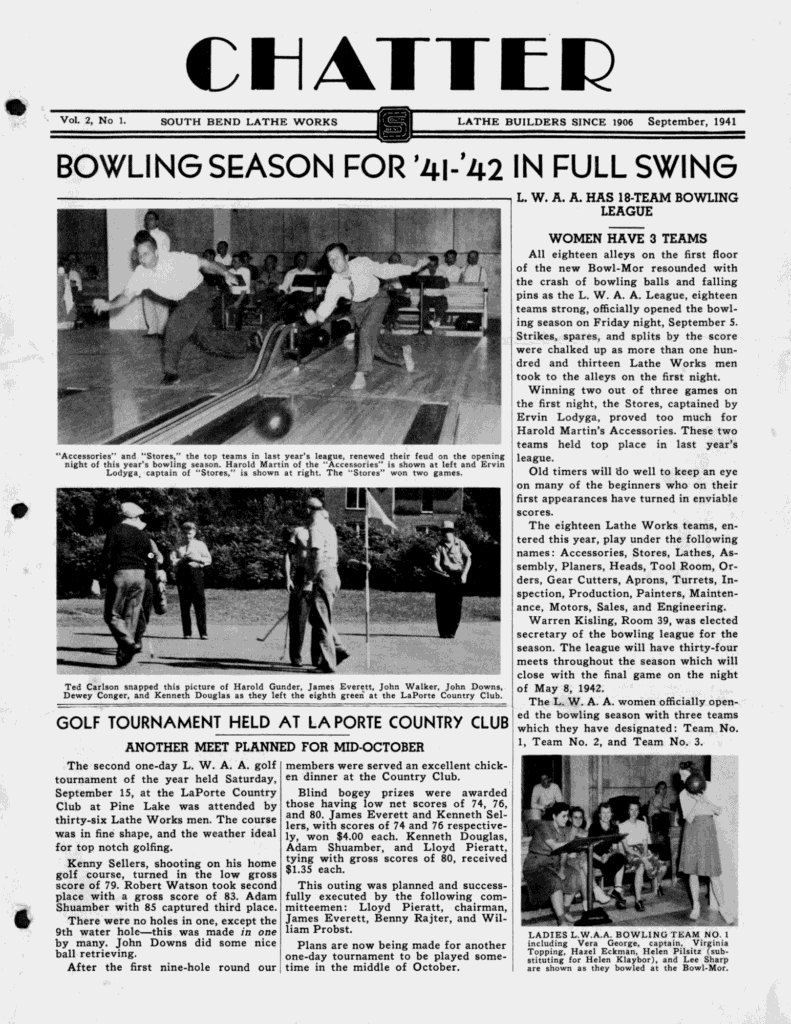
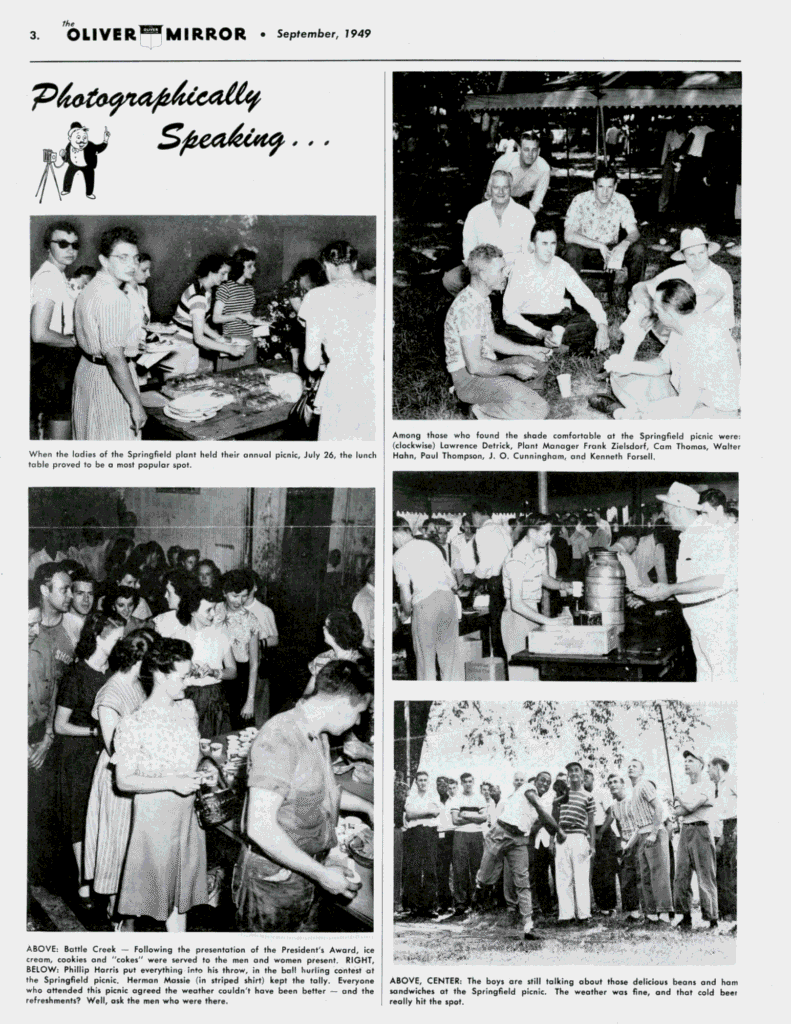
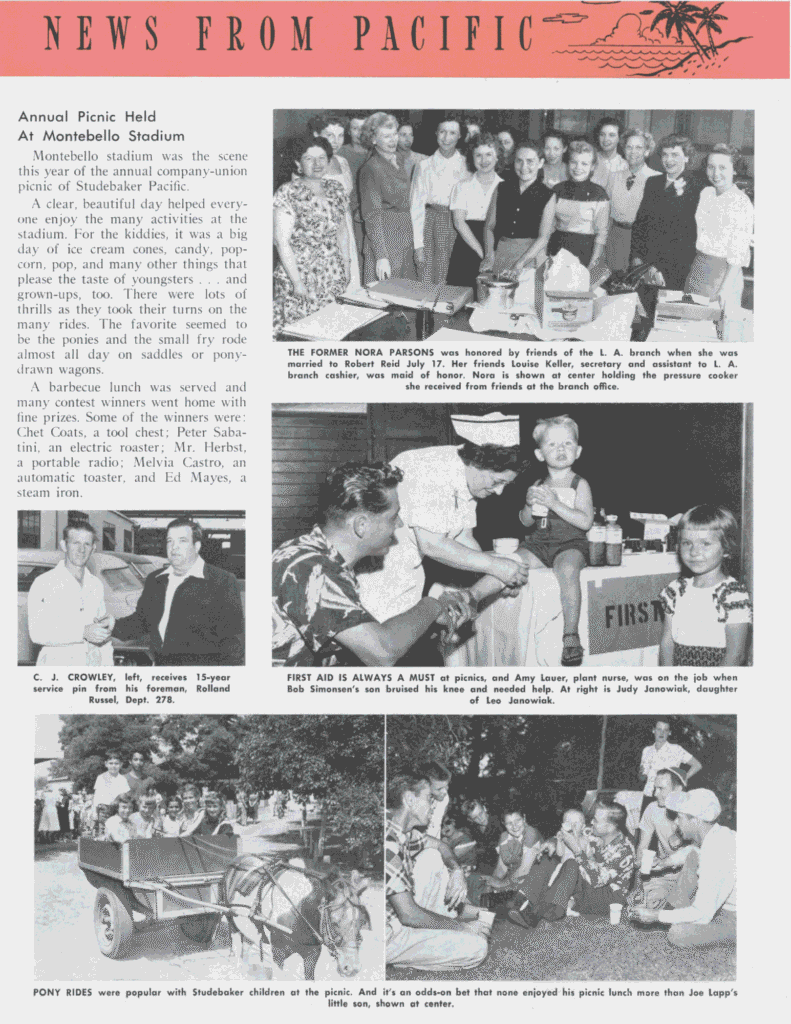
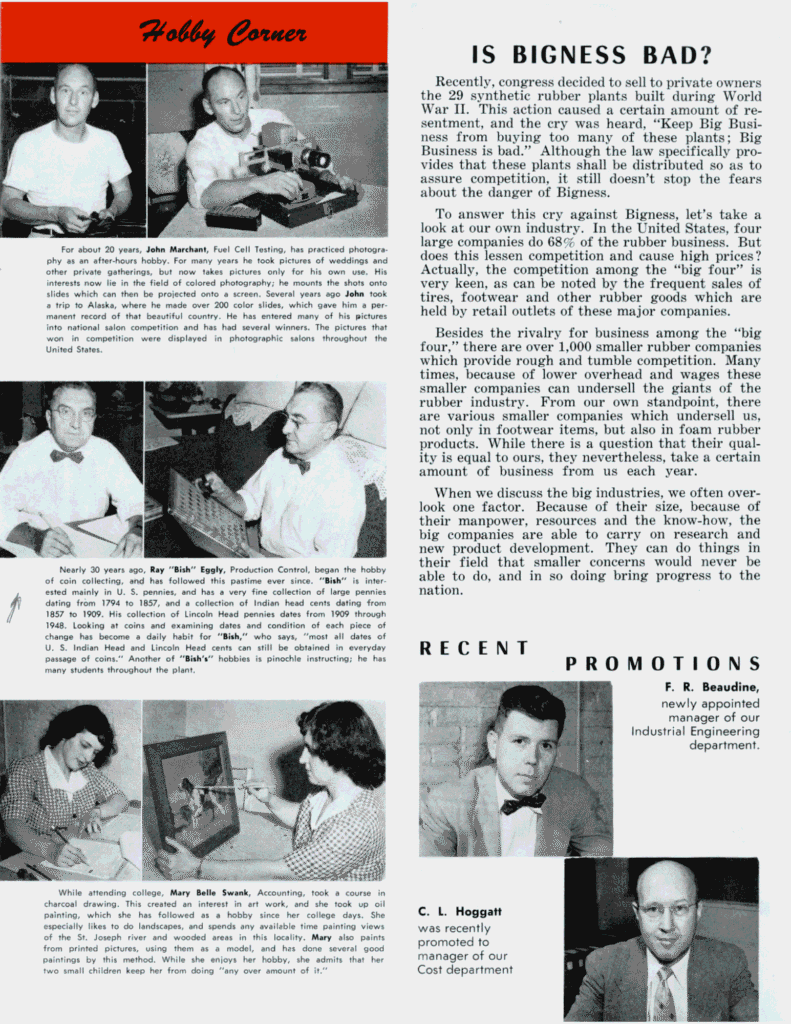
In a bygone era of South Bend’s industrious past, there was a commonality across manufacturers: the company newsletter. Employee newsletters featured all the updates, photos, and business news that was fit to print. Anything from a requested potluck recipe, retirement announcements, bowling league scores, and war news was laid out in the pages of these booklets. Oftentimes they included safety information and highlights from a particular department or sector of the workforce, so that everyone could get an idea of the combined effort it took to make the organization run. These internal publications offer an inside look into South Bend labor history, straight from the factory floor.
Learn about when business was booming in South Bend! These titles explore the industrial and labor history of our city.
The Reformer
1967-08-24
South Bend’s Notable Periodicals
Over the years, St. Joe County has been home to a wide array of newspapers, magazines, and newsletters that connect our community. Everything from Studebaker employee articles, bank robberies and crimes, marriage announcements, obituaries, rural potlucks and agriculture, to national headlines has made it into local publications. One paper to emerge in the mid 1900s was The Reformer, South Bend’s first newspaper by, for, and featuring Black residents.
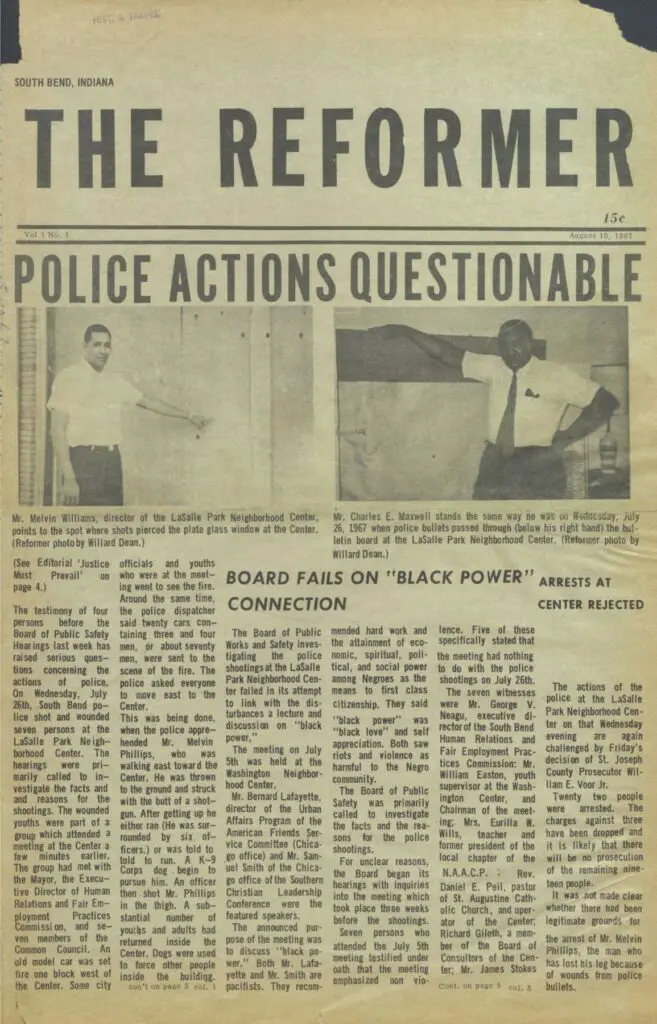
The Reformer’s inaugural issue was published on August 10th, 1967 and immediately took to addressing the pressing issues that were facing the community. “POLICE ACTIONS QUESTIONABLE” sprawls the first headline, drawing attention and demanding accountability from law enforcement’s shooting of seven people in LaSalle Park Neighborhood the previous month. Throughout the paper’s four year lifespan, reporters and contributors would go on to cover political topics, local events, and public interest pieces, bringing a pointed perspective to South Bend news coverage.
The Reformer’s first issue | 1967-08-10
A Lasting Mark on South Bend
But The Reformer also became a home for more neighborly news like block party clubs, school sports, church services, and advertisements for Black-owned businesses like Perry’s Pharmacy. Through photos, articles and stories this newspaper painted a picture of South Bend at the height of the 1960s Civil Rights Movement. And while the last issue was printed 55 years ago, The Reformer has forever left its mark on the people and news landscape of this city.
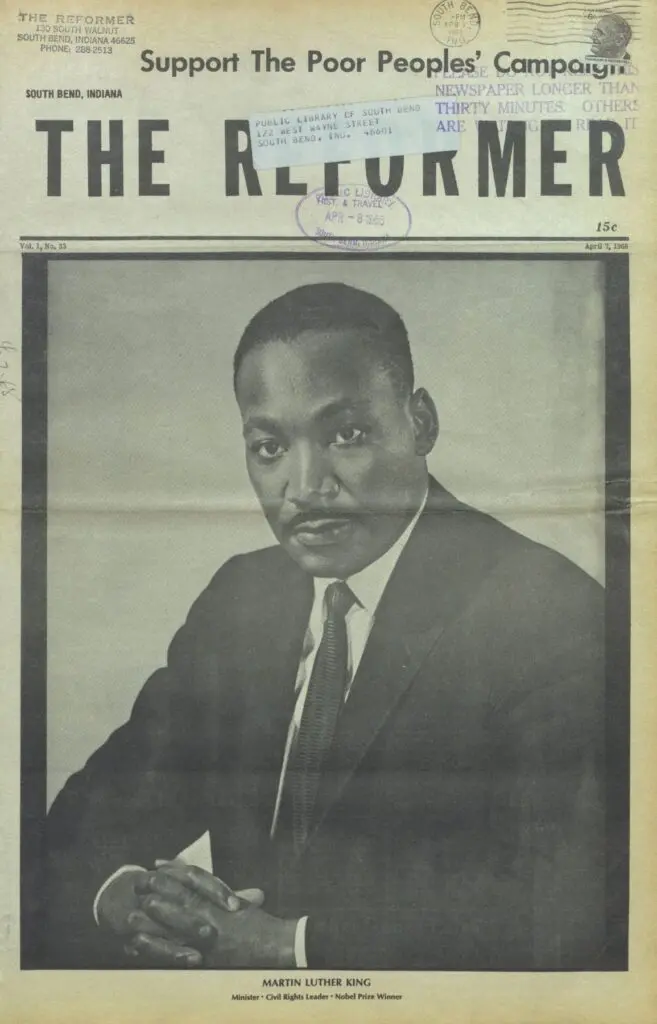
1968-04-07
1968-09-01
Michiana Memory Historic Newspapers Collection
Explore digitized issues of The Reformer through our digital collection on Michiana Memory!
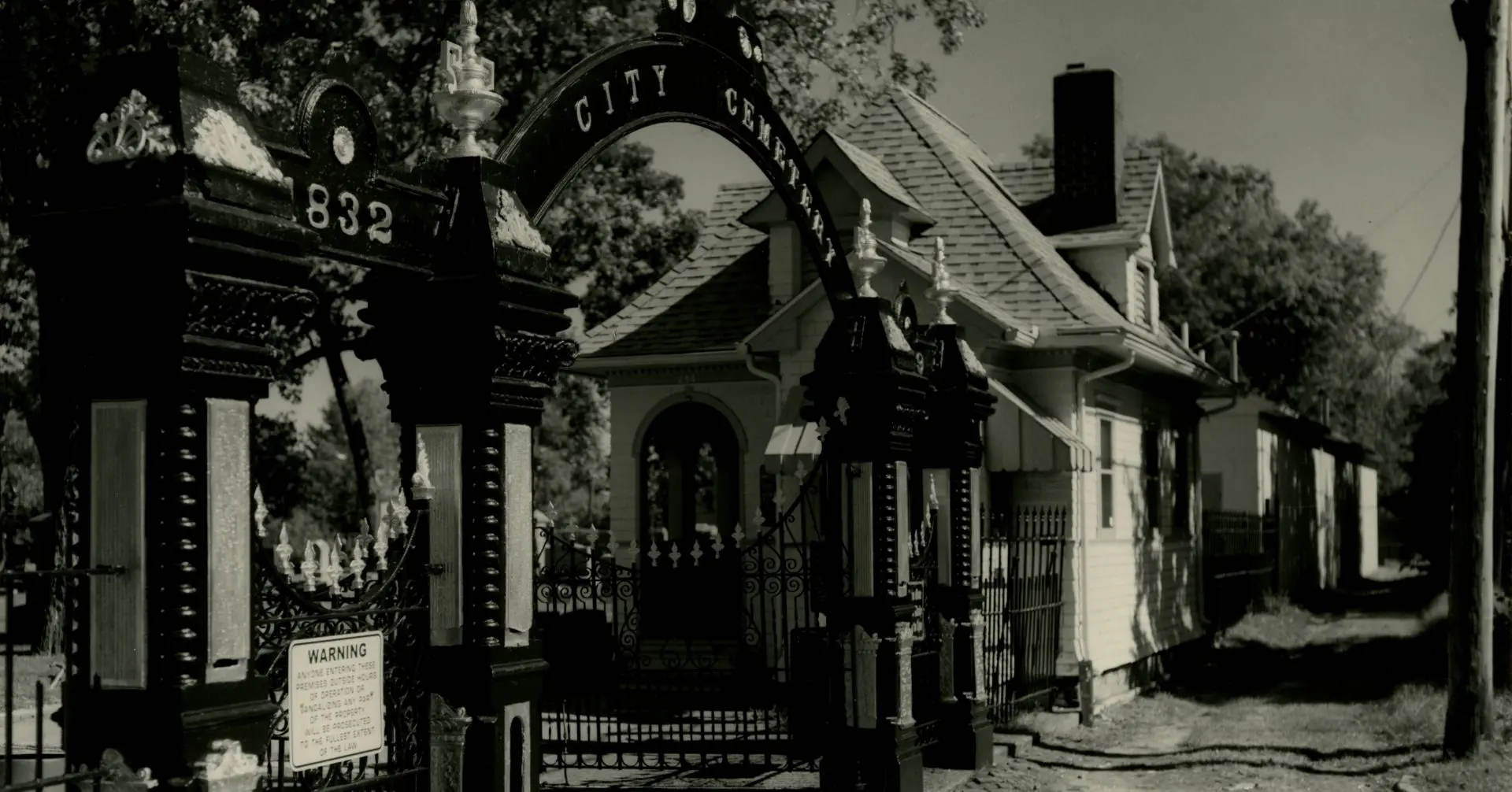
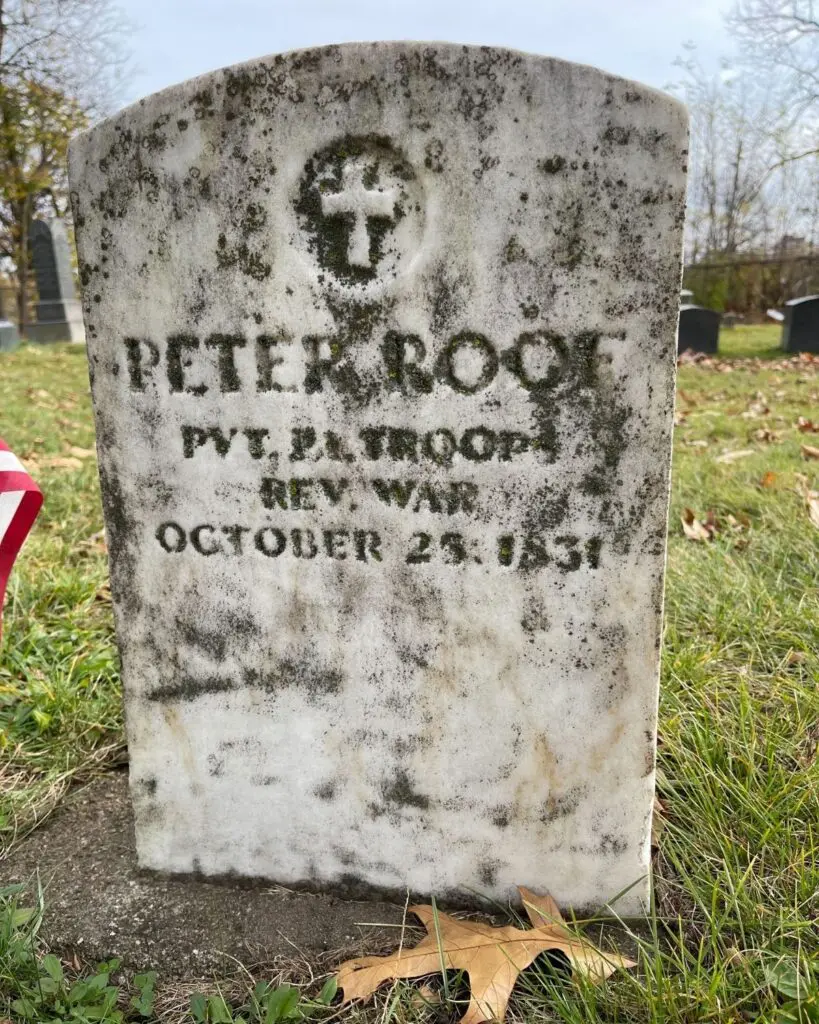
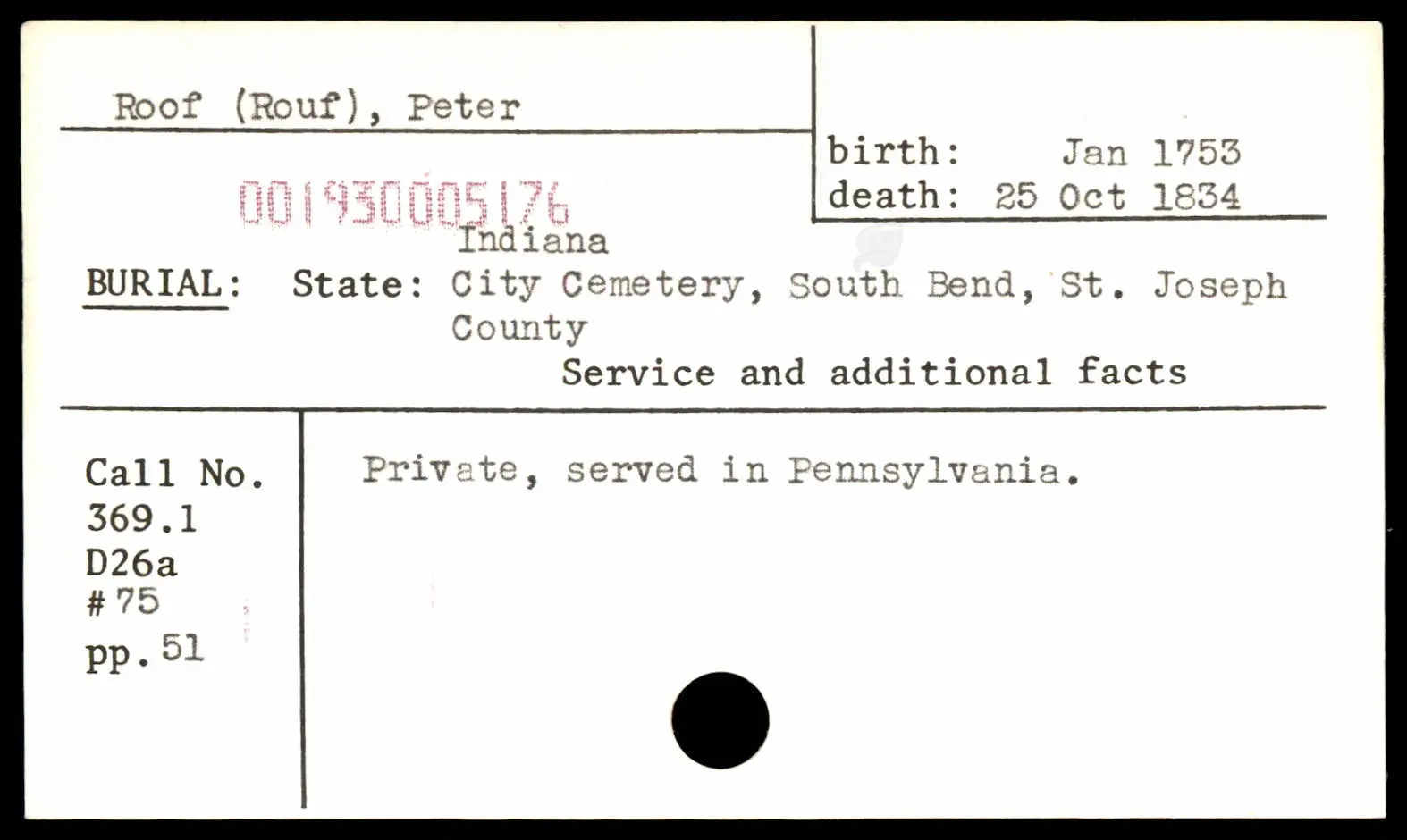
The year 1783 marked the end of America’s war for Independence but the beginning of a new chapter for many who participated in it. Revolutionary War soldier Peter Roof, born January 6th in Hagerstown, Maryland, ended up settling in the St. Joseph County region on land he was given by the government as payment for his time in the war. He lived until 1831 (though some records say he lived until 1834), and was buried in the first cemetery built in South Bend.
Record of Peter Roof from the U.S., Revolutionary War Burial Index, 1775-1875 from Ancestry.com
A Place of Peace After War
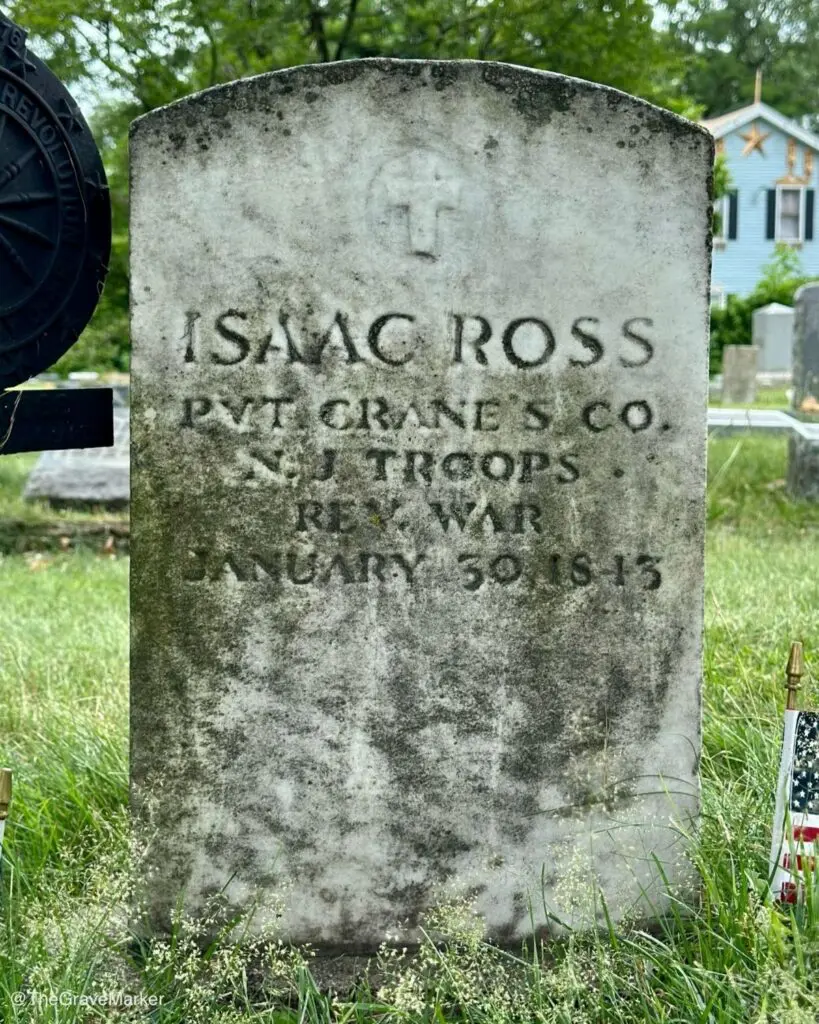
South Bend founders Alexis Coquillard and Lathrop Taylor drew up plans for the city, including the cemetery, in 1831, though the cemetery wasn’t officially opened until the following year in 1832. The grave of a second Revolutionary War soldier, Isaac Ross, born May 7th, 1760 in Westfield, New Jersey, can also be found here. Ross lived 12 years longer than Roof and was ultimately laid to rest in City Cemetery in 1843. Both Roof & Ross “lived to a ripe old age,” finding respite from their earlier years of battling by settling in the emerging town of South Bend to move forward with their lives after conflict.
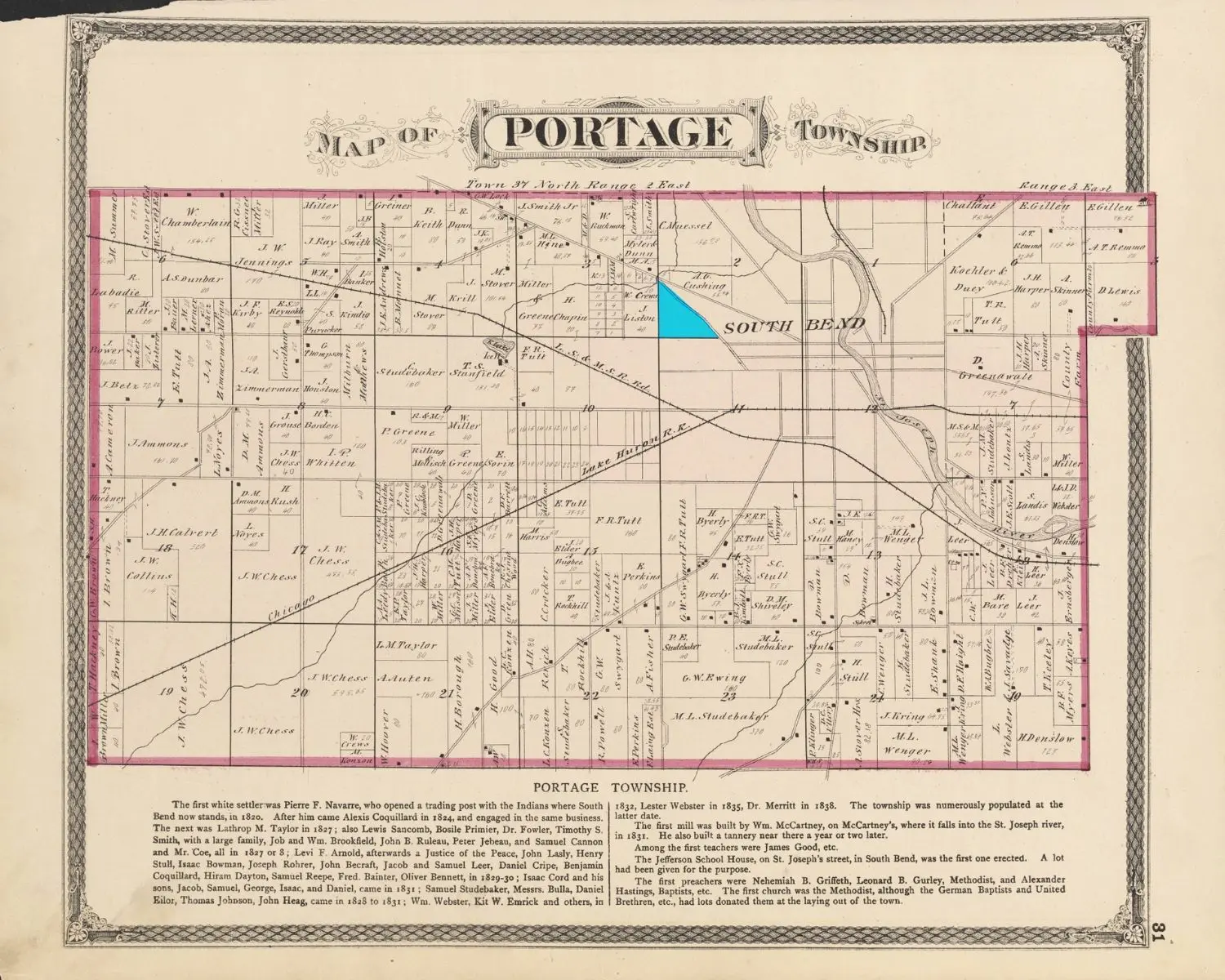
1875 map of Portage Township, South Bend with the location of City Cemetery highlighted.
Photo by Casey Martin on Find a Grave. | July 18, 2024
“SOUTH BEND IN THE EARLY WARS.
Among those who silently rest in the beautiful grounds of the City Cemetery, are the heroes who participated in every great American war from the Revolution to the recent war with Spain.
Of the revolutionary heroes are Peter Roof, Sr., and Isaac Ross, both of whom lived to a ripe old age” (South Bend and the Men Who Made It, 1901, p. 47).
What’s Happening in Local & Family History: The Mid-Year Bulletin
Summer is here! Read on for Local & Family History updates and find out what’s coming up.
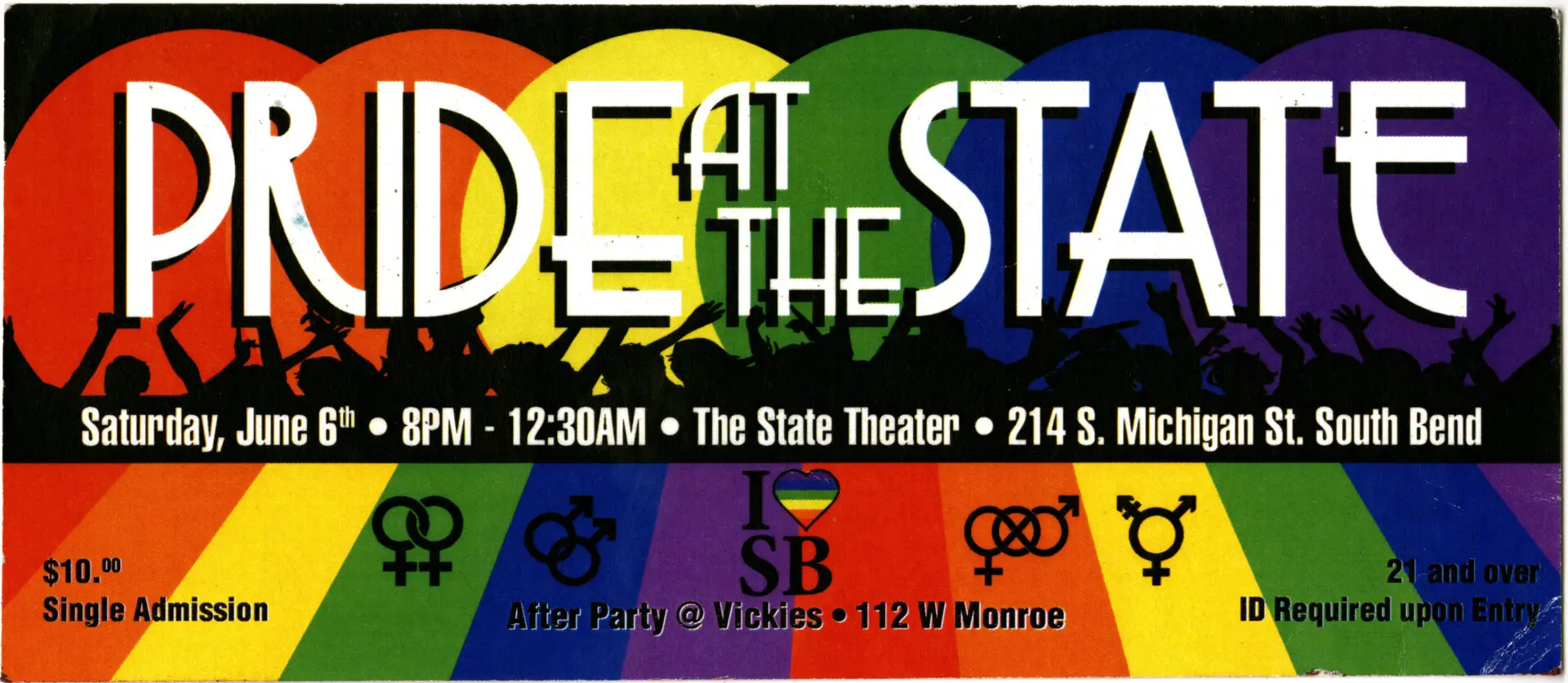
A ticket for an event entitled, “Pride at the State,” featuring drag and burlesque performances meant to promote LGBTQ pride. The event occurred on June 6, 2015 at the State Theatre in downtown South Bend, Indiana. | 2015-06-06
June is Pride Month! LBGTQ History in Michiana Memory
The LGBTQ+ Collection in Michiana Memory holds materials pertaining to St. Joseph County’s LGBTQ community from the 1950s to the 2010s. Items in this collection document social life, businesses, organizations, and activism of community members as well as include government activities regarding human rights. In this collection you’ll find photographs, event programs, newsletters, reports, and more. The original materials digitized for this collection were sourced from the collections of the Civil Rights Heritage Center at IUSB, but the library also collects such items for our own Local & Family History archives. Interested in donating or loaning items to grow the library’s archives of LGBTQ history? Contact us for more information!
My Wish for U.S. Systemwide Activity
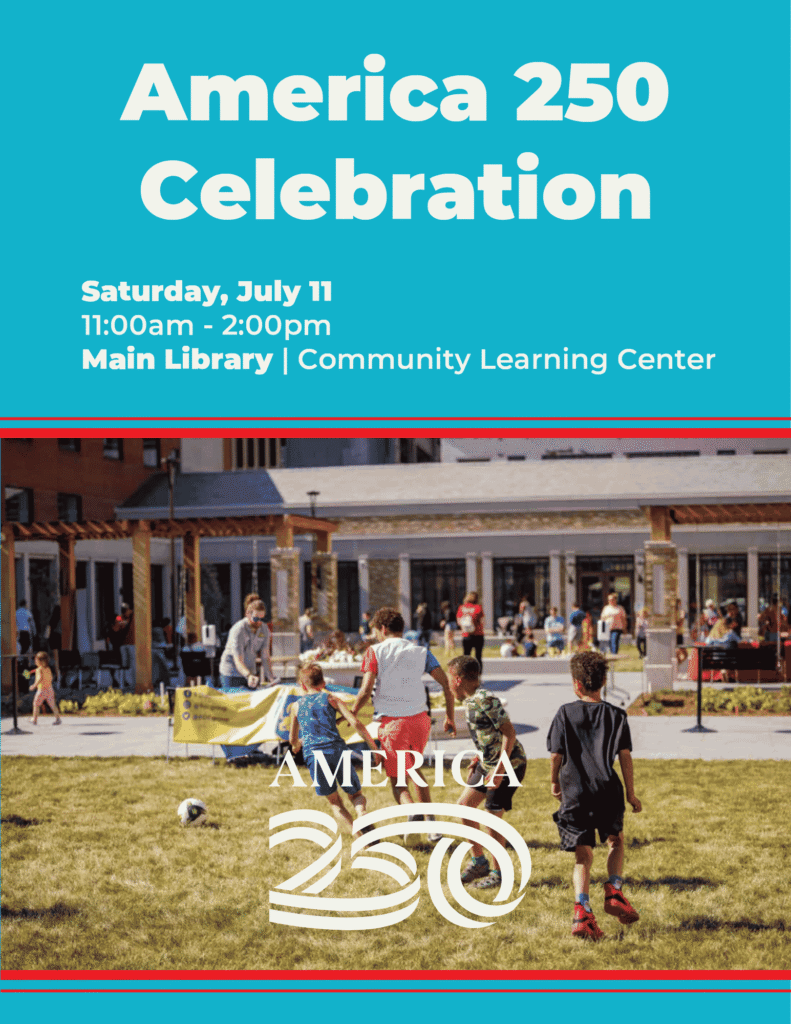
You may have seen paper quilt squares at your local SJCPL branch or in the Local & Family History Department. We’re gathering responses to the prompt “What is your wish for America’s future?” to display them as a giant collaborative quilt for the July 11th 250th event at the Main Library. Be sure to fill out a quilt square and put July 11th on your calendar!
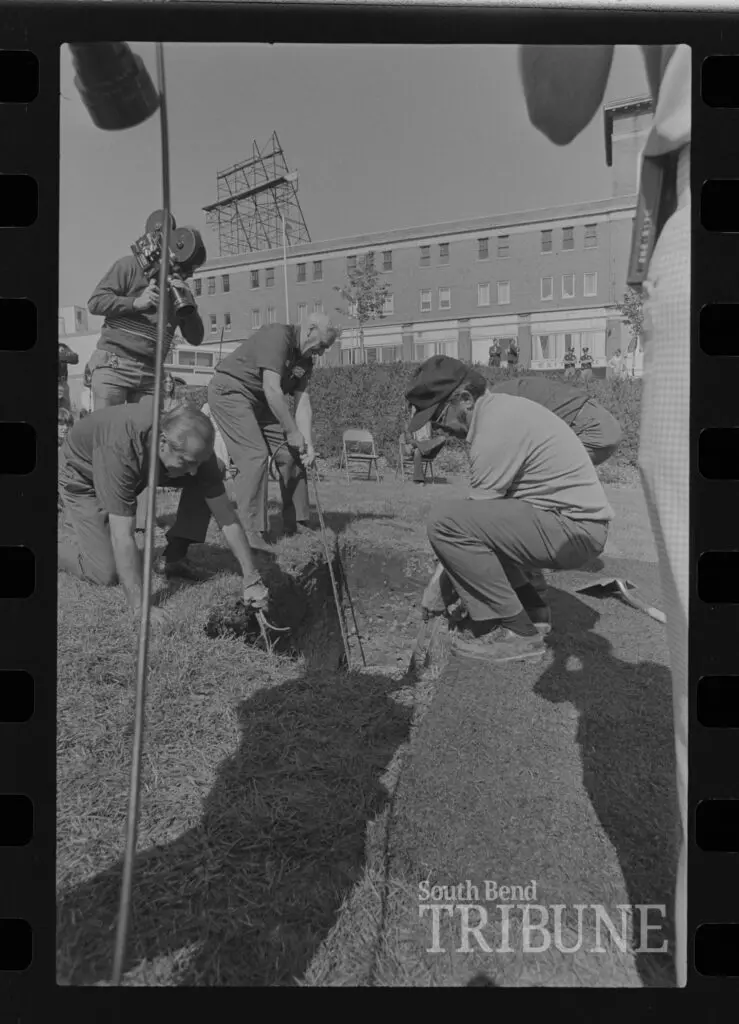
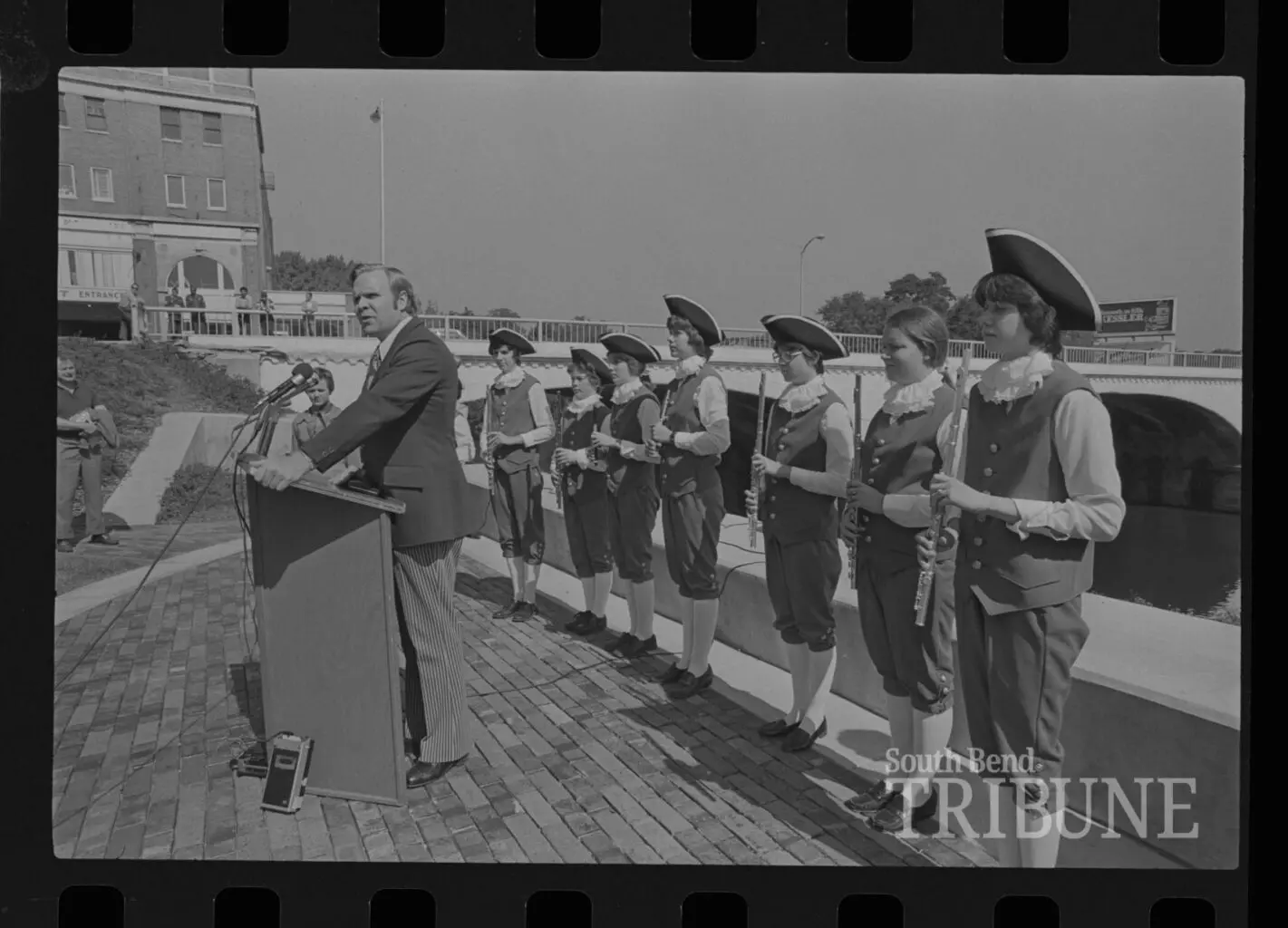
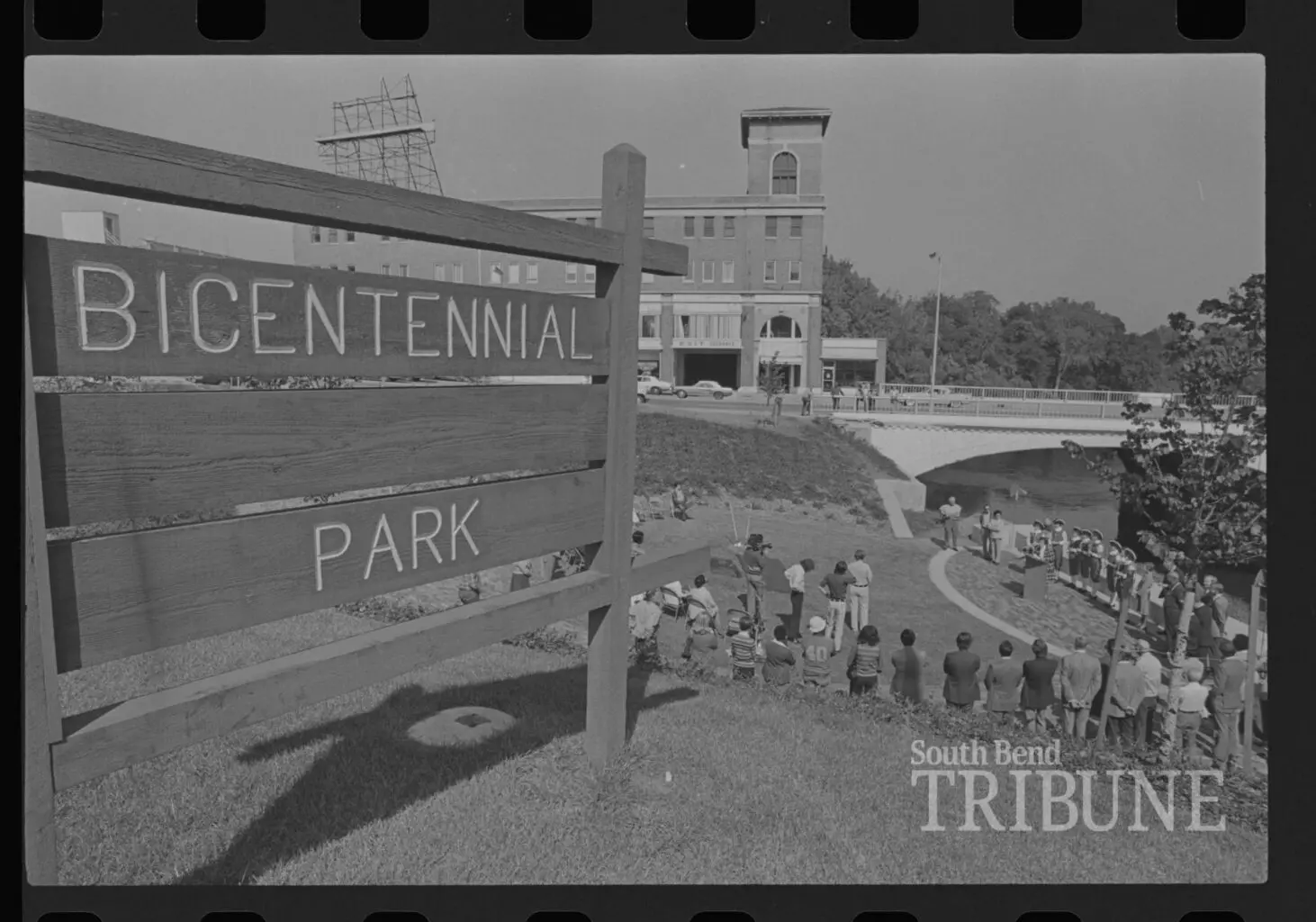
With a small crowd gathered, the capsule was lowered into the earth. Film crews captured the moment, reporters took notes, and students with tricorn hats and replica muskets shared the stage with mayor Peter J. Nemeth as he delivered an address. This was in 1976, and South Bend — like many other towns and cities across America — was taking part in Bicentennial celebrations to mark 200 years since the signing of the Declaration of Independence.
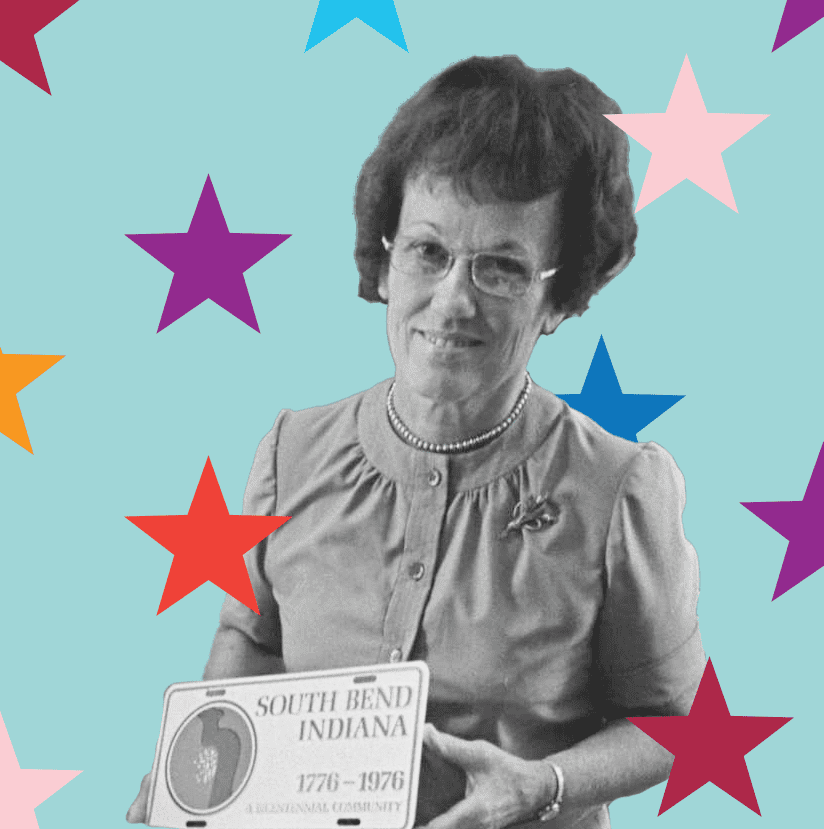
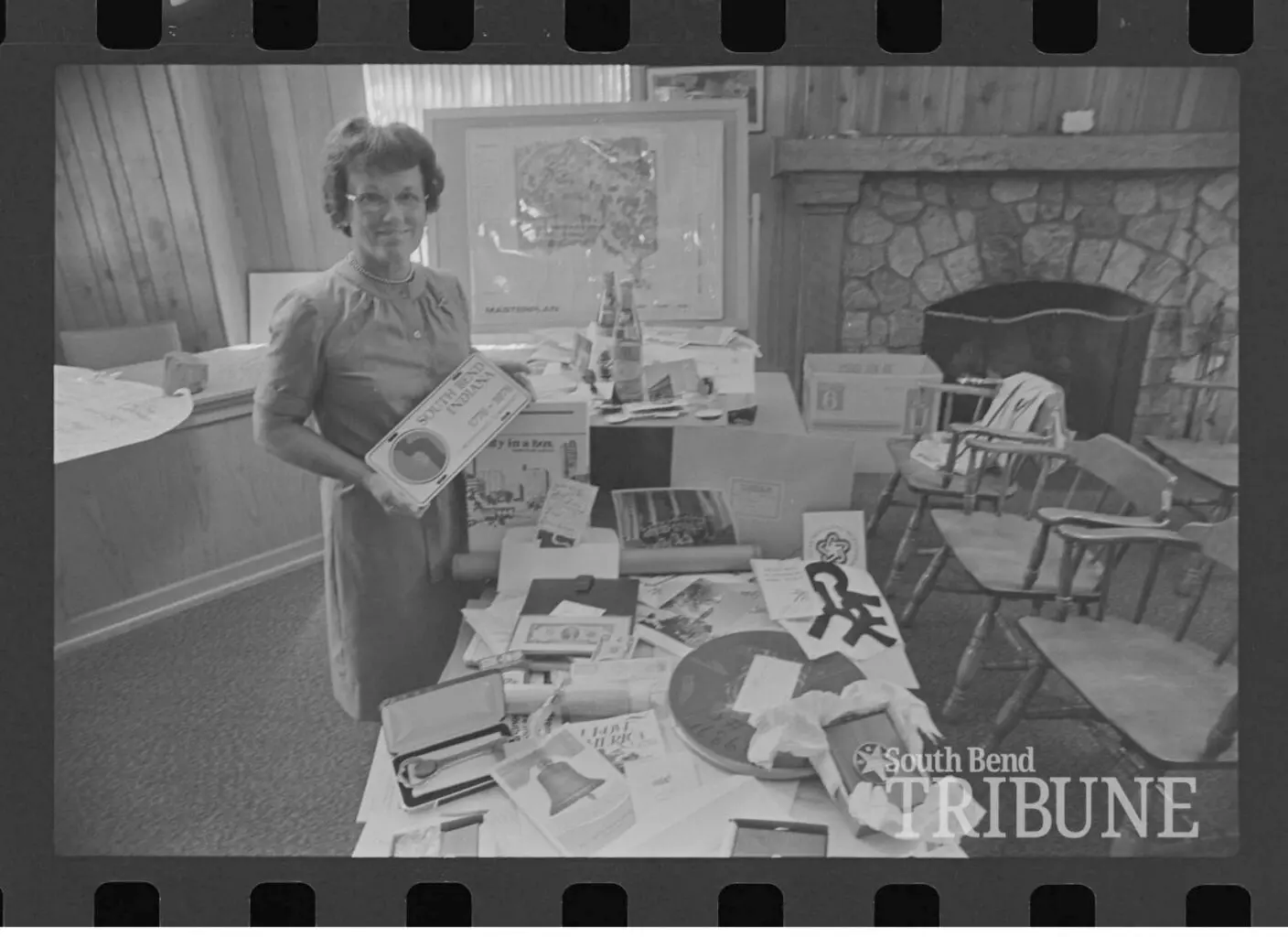
One woman took up the charge of traveling through time to coordinate the capsule: Chairwoman of the South Bend Bicentennial Committee Gwen Stiver. Stiver was active in the South Bend community over the course of her life, serving for a number of years as president of the South Bend Park Board, leading development projects for the East Race and Coveleski Stadium, and organizing South Bend’s first Ethnic Festival (now reimagined as Fusion Fest). She continually volunteered her time to bring events and projects to life for residents of South Bend, helping to beautify our parks and contribute to a shared sense of place. The time capsule was buried in Bicentennial Park on the corner of Lasalle and Martin Luther King Jr. Drive, but the park was later renamed Gwen Stiver Park after her death in 1997.
Time Capsule Lowered
A 150-pound time capsule was lowered into the ground of Bicentennial Park to be opened in 100 years. | 1976-10-01
Mayor Peter J. Nemeth delivered an address at the lowering of the Bicentennial time capsule. | 1976-10-01
A 150-pound time capsule was lowered into the ground of Bicentennial Park to be opened in 100 years. | 1976-10-01
Gwen Stiver
A time capsule will be buried in Bicentennial Park for people to open in 100 years. Pictured is Gwen Stiver, chairman of the South Bend Bicentennial Committee. | 1976-09-27
Fifty years from now in 2076, for America’s Tricentennial, the time capsule will be unearthed and we’ll be able to reminisce on its contents with nostalgia. It may not be that a single time capsule can capture the feelings of an entire city at a certain moment in time, but it’s the act of preservation that speaks to our human desire for connection and recognition. We have been here…we are here…we will be here, steadily traveling forward in time together through whatever the future holds. And people like Gwen offer the reminder that it’s the continual effort of pouring into our community that really marks the time and makes the change.
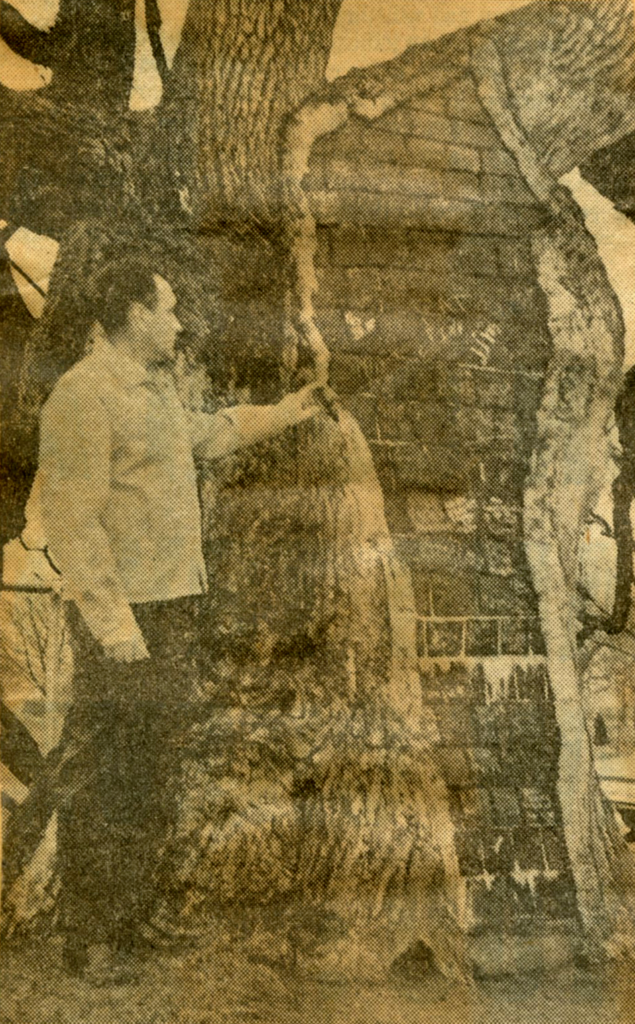
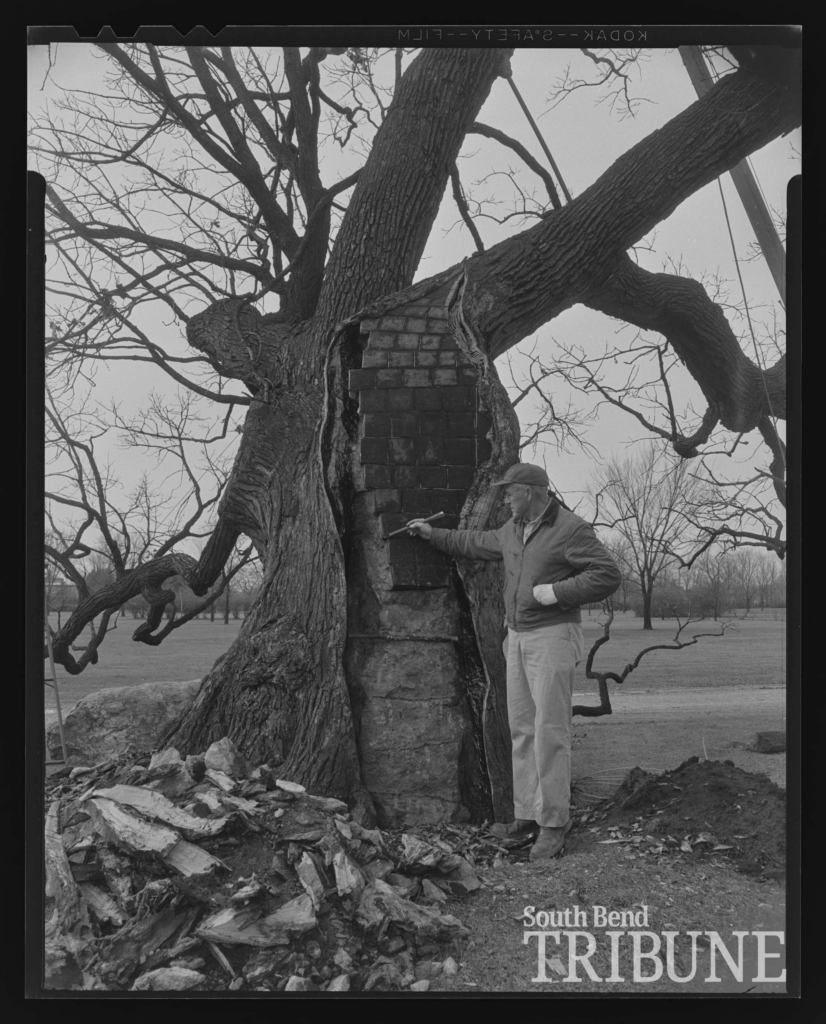
Edsel Wiseman, owner of Moore Tree Experts, 51933 Orange Rd., points to a large hole which was filled with bricks to help preserve the Council Oak. Two large trunk limbs were ripped away during a wind storm 25 years ago. | South Bend Tribune, April 3, 1966
Oscar Munson
Oscar Munson, a tree surgeon, is making an effort to further preserve the landmark Council Oak tree located in Highland Cemetery. | 1957-11-17
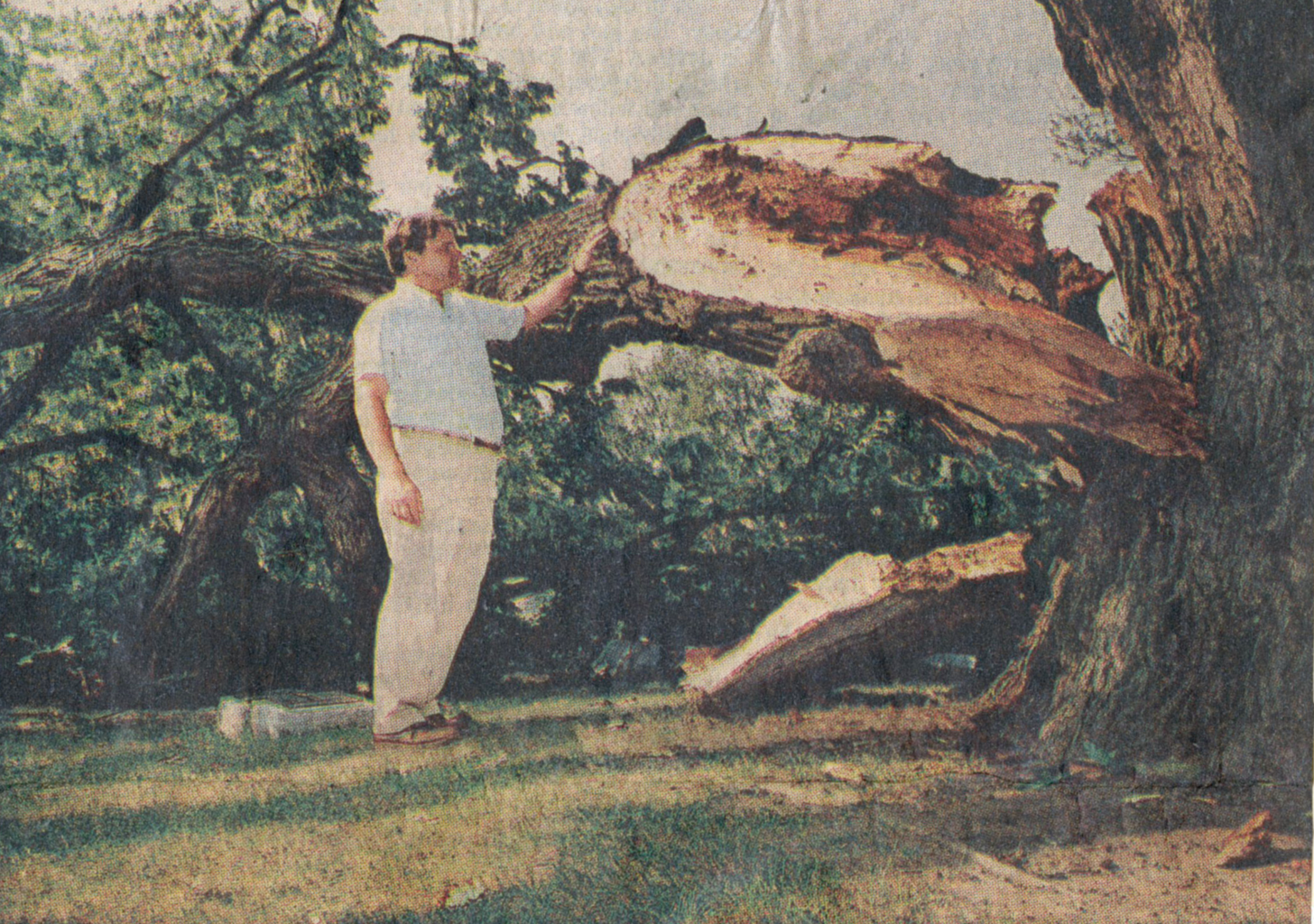
Terry S. Miller, president of Highland Cemetery in South Bend, examines Council Oak’s fallen limb. The limb fell about 2 p.m. Friday. Tree specialists will be called next week to determine what is next for the historic oak. | South Bend Tribune, August 25, 1991
A Living Monument Rests
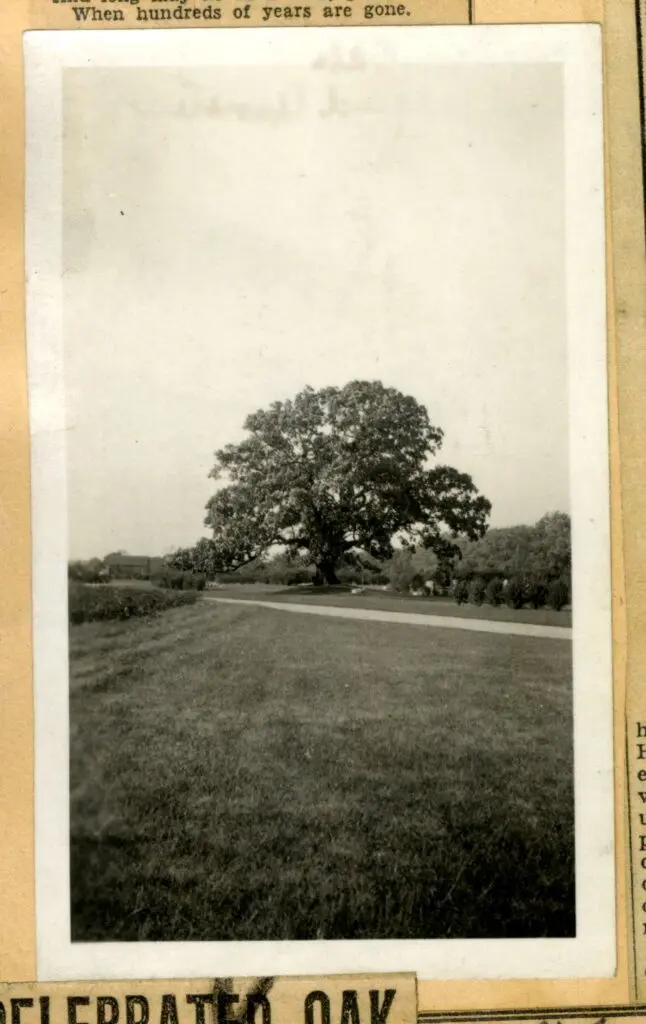
Edsel Wiseman looked up at the ancient oak. “Everything has to end,” he said. It was 1991, and the enormous tree had put its branches to the wind for a final time. A summer storm split the trunk and folded the outstretched limbs down to earth, where they lay draped over gravestones at Highland Cemetery. Wiseman was no stranger to the Council Oak. Over decades he performed and consulted on several rounds of arboreal surgery and the construction of support systems to prolong the life of the St. Joseph County sentinel. But even before Wiseman took on the task of maintaining the tree, others before him watched over it and saw to its slow and steady preservation in life and legend.
Centuries of Holding Space
The Council Oak was witness to hundreds of years of history, estimated to already have been four hundred years old at the time of LaSalle’s journey in 1681. The French explorer, whose name can be found all over South Bend, first landed at the Kankakee portage in December of 1679. A few years later LaSalle and his group held a meeting with representatives of the Miami, Illinois and Potawatomi nations to form an alliance against the Iroquois. The legend holds that this meeting took place under the sweeping branches of the Council Oak, and that it acted almost as an included party. Before America existed as we know it, the tree sat on open land, an adolescent waypoint for Native Americans and foreign travelers alike. Then its surroundings were cultivated into farmland, where the oak watched as plantlife all around shot up from the soil to join its wonderment for the sun. As the property became Highland Cemetery, the Council Oak found itself in the company of other souls laid to rest.
Wisdom of the Oak
In almost every writing you can find about the Council Oak it is alive and observing. It is aware, as all living things usually are, of who and what is around, and that the years are ticking by while it holds a reverent watch. But while it lived, it was participating in history and daily life as it happened. It is just as likely that it held steady as children climbed its limbs, as squirrels squabbled and threw acorns from its branches, as birds nested and sang in its company, as someone young and unsure rested against the trunk and looked into its canopy to ground themself in the certainty of growth. And just like the oak did, we should embrace the breeze and the feeling of sun on our skin, marking each moment in time like a sacred ring, and remembering those who helped support us along the way.
References
Dits, J. (1991, October 13). Branching out. The South Bend Tribune, p. G1.
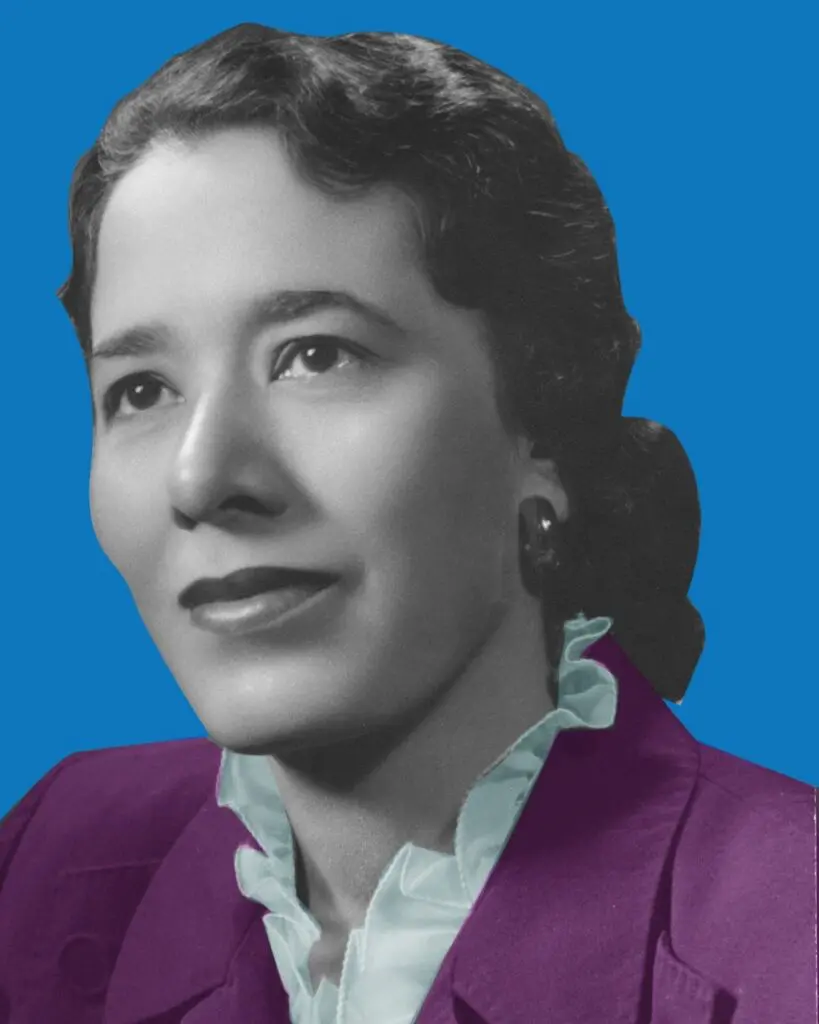
Original image of Josephine Curtis via the Northern Indiana Historical Society.
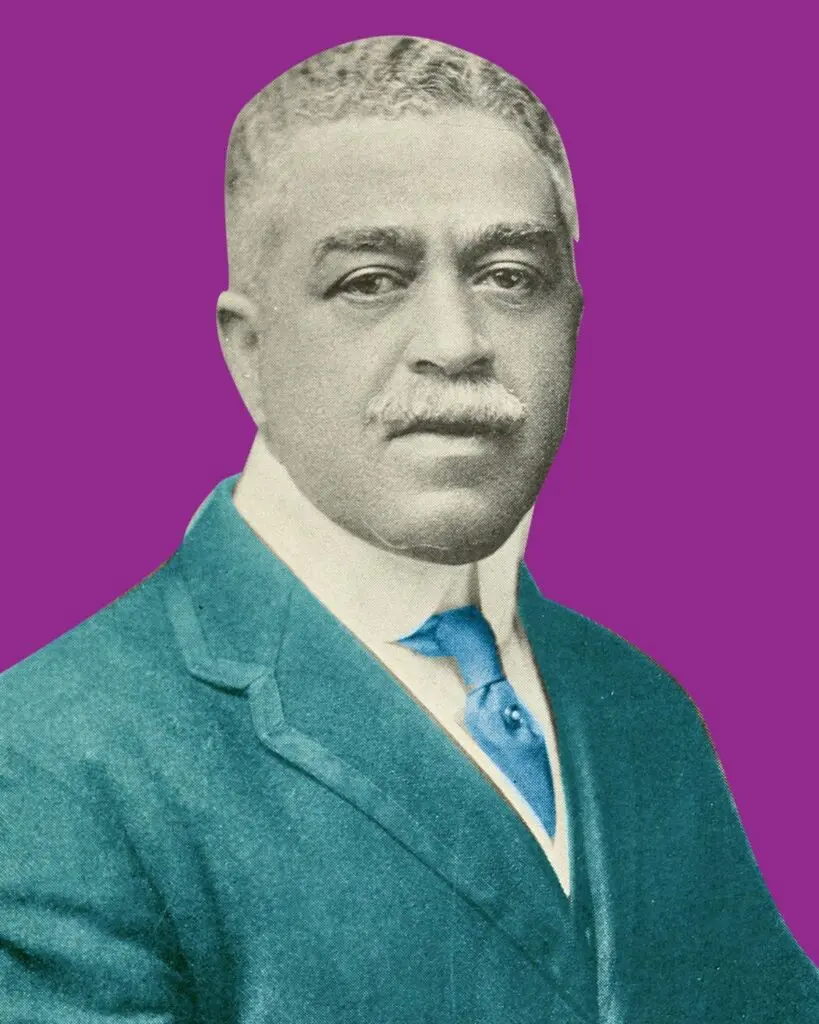
Josephine Curtis spent her lifetime on a quest for beauty. From studying at the University of Chicago, to honing her skills at the Kroeger School of Music in St. Louis, to directing operatic stage performances in South Bend, she endeavored to bring beauty into every part of her life. In 1933, after Curtis relocated to South Bend from Missouri, she formed the H.T. Burleigh Music Association, whose aim was to highlight and make space for Black musicians. The organization’s namesake was Harry Thacker Burleigh, a renowned singer and composer whose ability to arrange melodic reimaginings of African American spirituals struck Curtis as a shining example of the beautiful complexity of the Black American experience.
Josephine was drawn to the way Burleigh — whose grandfather taught him the traditional African American spiritual songs he learned during his years of enslavement — was able to recontextualize the music into modern compositions to be shared with new audiences. Roland Dickinson (1992), a student of Curtis, described the connection Josephine drew between her musical endeavors and those of H.T. Burleigh:
There is something magical in some names, and the magic in Burleigh’s name carried through in this local organization ….Curtis thought the Burleigh name tied in with two important purposes for her group. First, she wanted to give the African-Americans of South Bend who studied, knew and loved music a vent for expressing themselves. Secondly, this group would let people know that the spiritual was not the only music known by the African-American. She wanted the community to know the universality of music, that music has no ethnic bounds, that music can be enjoyed as well as sung by anyone who wants it (p.F7).
Curtis’ quest for beauty didn’t stop at the H.T. Burleigh Music Association and their productions, it extended into her daily life. She was an active member of the South Bend community, volunteering her time and effort to many different organizations and groups in the city, including as “president of the citywide Parent-Teacher Council, active supporter of the South Bend Chapter of United Nations, trustee of the South Bend Urban League, and board member of the Michiana Arts and Sciences Council” (2000). In addition, Josephine was “a charter member of the South Bend Women’s Council for Human Relations. She was instrumental in the council’s development of fair housing codes, the establishment of employment opportunities for all, and the desegregation of hotel and restaurant accommodations” (South Bend Education Alliance, 2000).
Singer, composer & arranger H.T. Burleigh. | ca. 1918
Josephine’s commitment to enriching the lives of South Bend residents through the arts and through material means is a powerful reminder of the effort it takes to bring your vision to life. Sharing music with each other is beautiful, building up a community is beautiful, fighting for a better future is beautiful. The quest for beauty is not just the pursuit of art, but a lifetime of asking how you can contribute your talents, passions, and creativity to manifest the world you want to see.
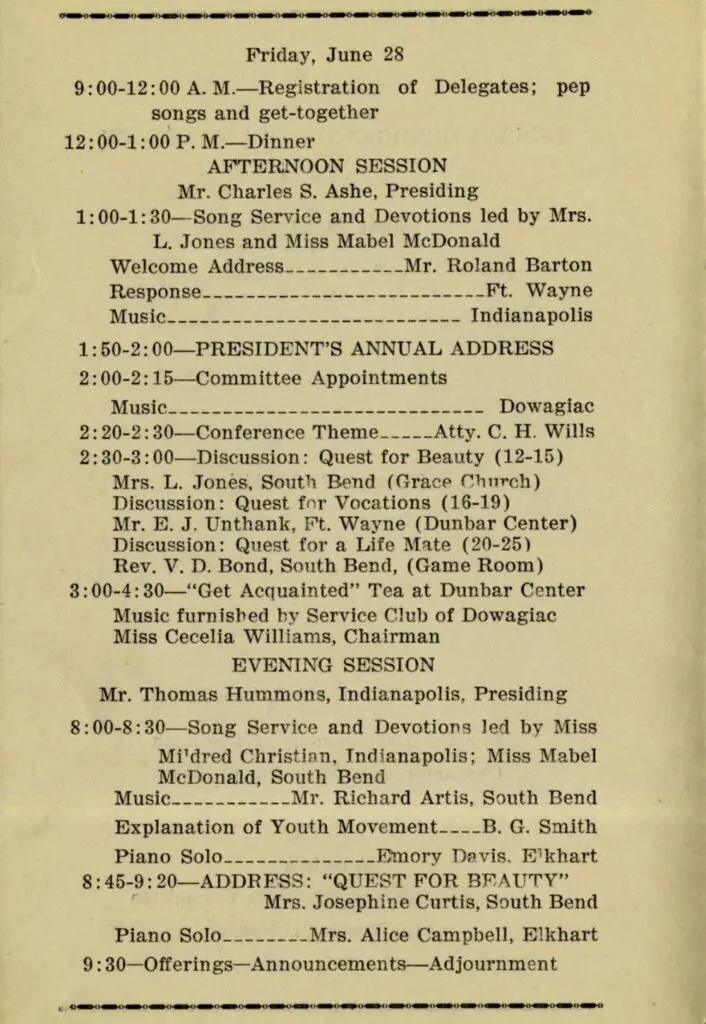
Booklet for the Indiana-Michigan Youth Conference held in South Bend in 1935.
Some sessions took place at Olivet AME Church. Includes presentations by Charles Ashe, C.H. Wills, B.G. Smith, J. Chester Allen, and others. Among the activities were speeches, discussions, and music. Topics included business, spiritual growth, health, and knowledge. Participants were from South Bend and the local region including Elkhart, Dowagiac, and Fort Wayne. | ca. 1935
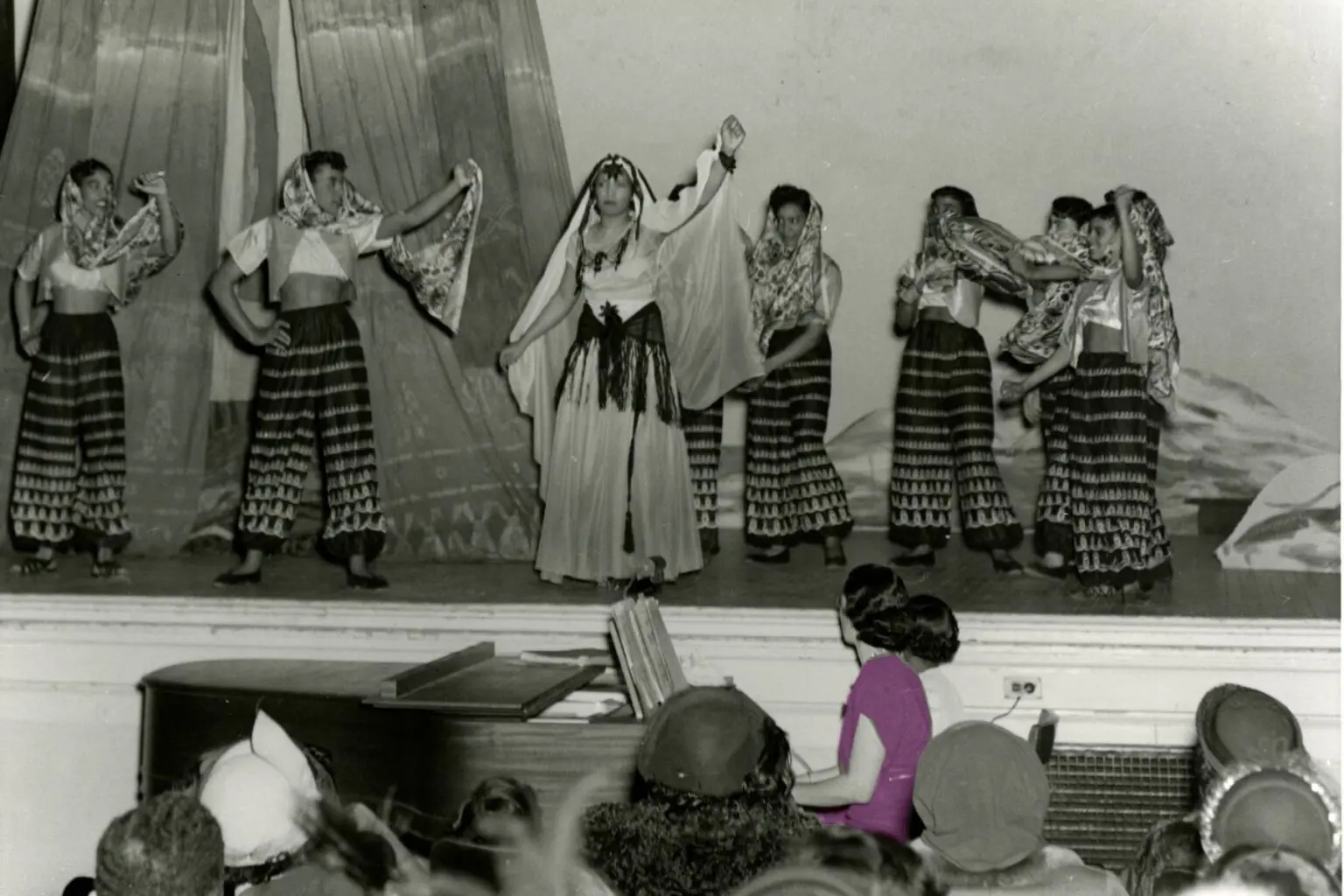
A photograph taken during a performance by the H.T. Burleigh Music Association at the Hering House, depicting Josephine Curtis, Roland Dickinson, Georgia Ward Bryant, et al. | ca. 1949
Pull quotes
“She wanted the community to know the universality of music, that music has no ethnic bounds, that music can be enjoyed as well as sung by anyone who wants it.” – Roland Dickinson (student of Josephine Curtis, 1992)
“Music seemed to be the driving force in Curtis’ life, but she shared her many other talents and her time unselfishly for the betterment of the Michiana community. She worked diligently for ethnic harmony, for better housing and all the avenues of life that help people better themselves and enjoy a fuller life.” – Roland Dickinson (student of Josephine Curtis, 1992).
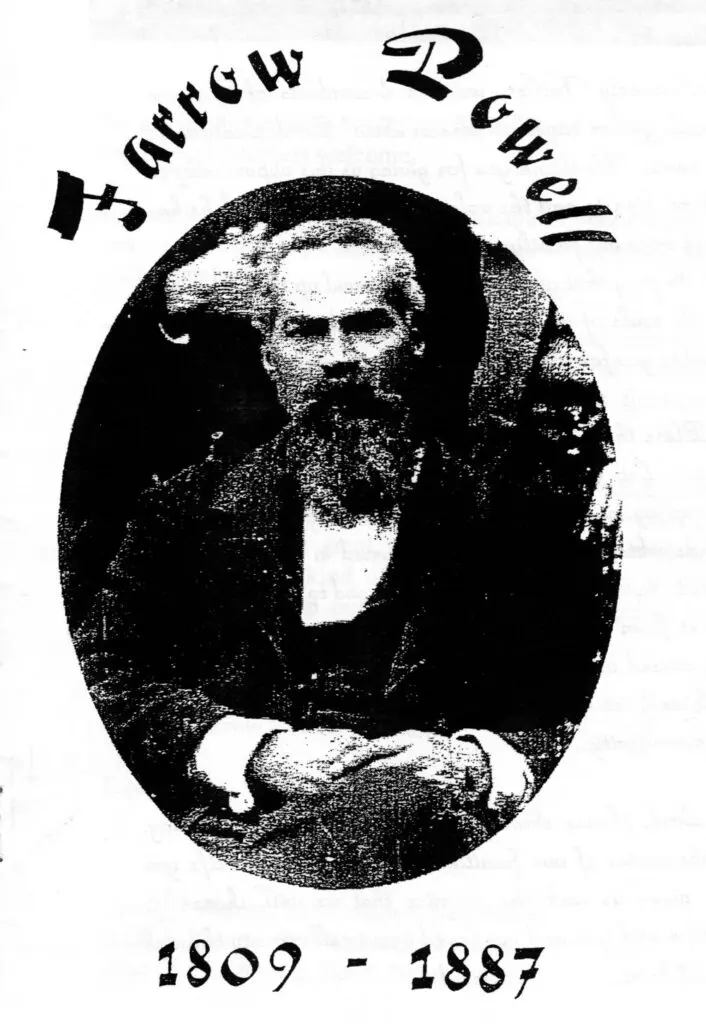
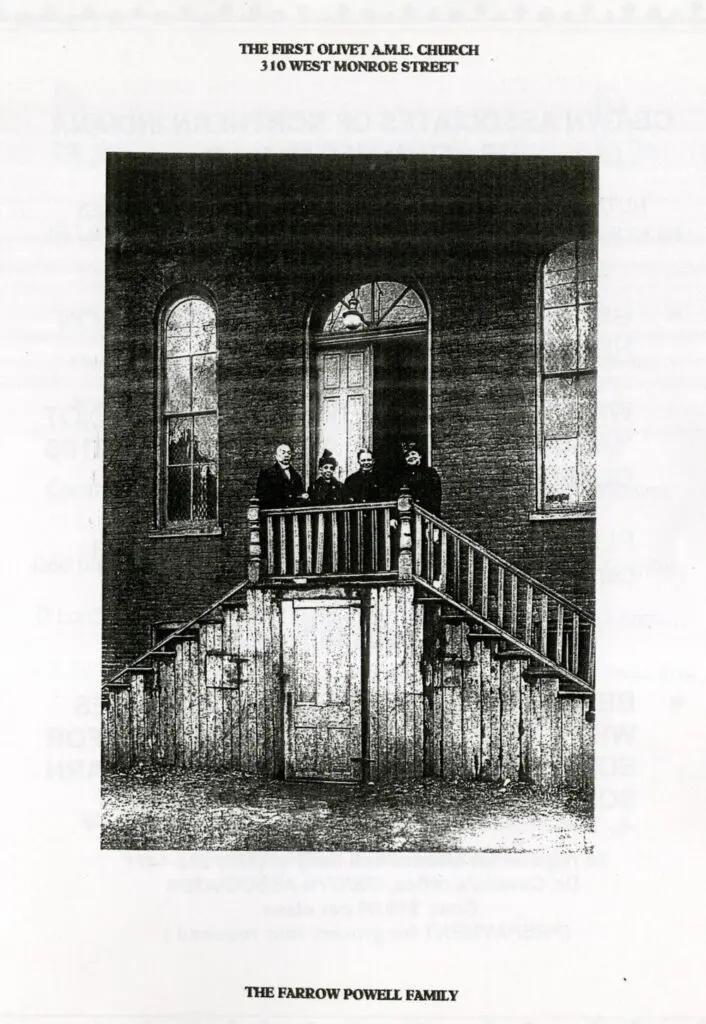
Farrow and Rebecca gathered up their belongings, their children, and their hope for the future, setting out northward for South Bend, Indiana. First from North Carolina then to Southern Indiana, they continued on to forge a path of greater opportunity for their family. The year was 1858, and the Powell family became one of the first Black families to settle in South Bend. The Powells were a hugely influential family to the area. They were active in the community, buying multiple properties and using their resources to help establish anchor sites like the Olivet A.M.E. church in 1870. Their home was located on the 400 block of Main Street, one home among a handful of Black homesteads in the burgeoning South Bend. In an oral history interview, Powell family descendant John Charles Bryant described growing up on Main Street: “Main Street was a very rich heritage. All the families were supportive of one another. Nobody went hungry…if somebody needed something, the brothers came together.”
A Changing Community Landscape
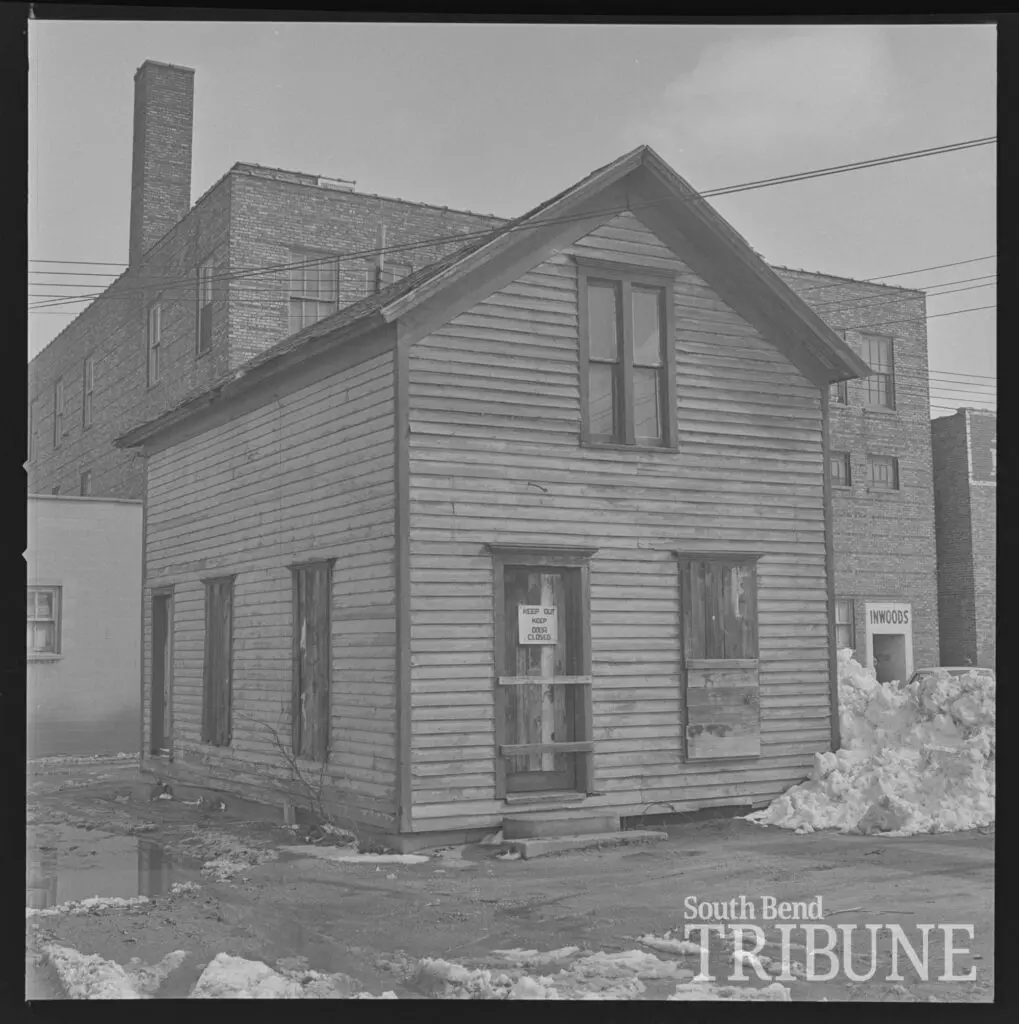
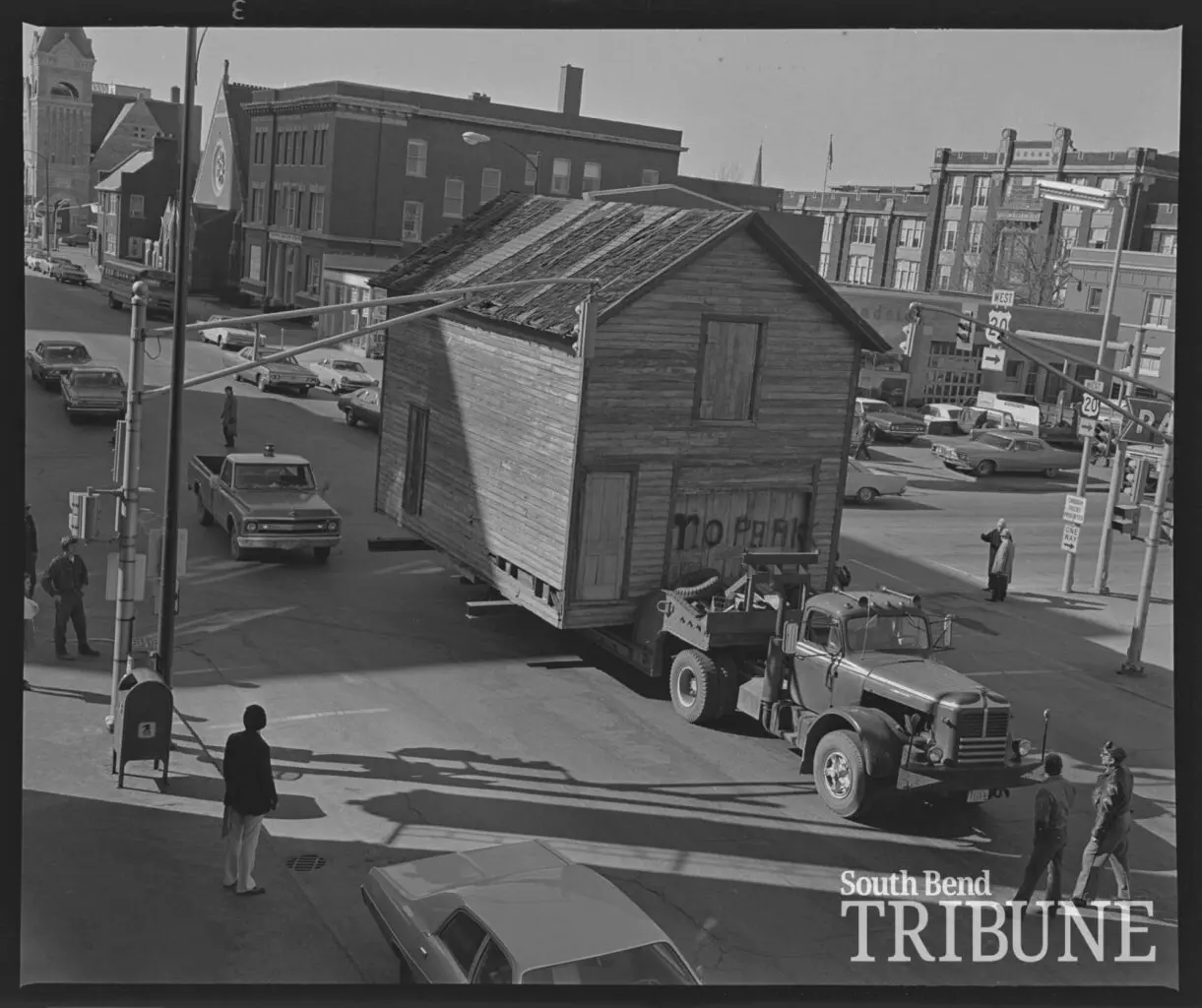
Eventually, the neighborhood began to change and Main Street neighbors relocated. “Our house was the last standing house,” Bryant remarked, “all the other relatives had sold their houses.” The Powell family home later sat vacant in the Innwoods parking lot, a lone structural island in a sea of urban development and asphalt that had sprung up around it. Boarded up windows relegated this prominent South Bend structure to slow disappearance, until 1973 when local high school students took up the cause to preserve it. The home was lifted up on the bed of a trailer and relocated to Leeper Park following the students’ activism, making its way through the city streets as a one-house parade.
These photographs depict historic Powell House, the oldest remaining black-built house in the city, being moved to Leeper Park from an alley between S. Michigan St. and Main St.
Carried Forward in Memory and Community
Devastatingly, the Powell home was vandalized repeatedly after its relocation, and was ultimately destroyed by an arsonist’s flames in 1980. But what the home stood for, the intrepid spirit of Black hope and community togetherness, remains. The history that John Charles Bryant shared about his family legacy and the Main Street neighborhood lives on to inspire us to connect with our neighbors, build strong bonds with each other, and work together to construct our hope for the future one story at a time.
Program for the 1998 Farrow Powell Reunion. Includes early family history, details about the reunion and cemetery listings for family members. | 1998
Program from the 140th celebration of Olivet African Methodist Episcopal (AME) church on May 2, 2010. Contains a list of events, with speakers including former CRHC Interim Director Alma Powell. Also includes a history of the church, the oldest African American church in South Bend. The program is a gift of John Charles Bryant. | 2010-05-02
Robinson, Rev. C.G. & Perry, Rev. L.J. (1974). Olivet African Methodist Episcopal Church: 1870 – 1974. Pictorial Church Directories of America, Inc.
Semiquincentennial
America is Turning 250
This year, America turns 250 years old. It’s our country’s semiquincentennial anniversary, which means that this July 4th will mark 250 years since the Declaration of Independence was signed. This significant date allows us to reflect on our nation’s past, investigate the present, and think about the future. Throughout the year we will consider how individual narratives come together to weave the tapestry of our neighborhoods, towns & region.
And while Indiana was not yet a state in 1776, we will still be creating space to think about what the landscape of our county looked like at that time, who the land was stewarded by, and how it has changed over the years.
We’ll be contemplating which groups were excluded from the original vision of America and how people have worked together through history to affect change toward a more inclusive future.
And we’ll be looking ahead to see how preserving and sharing our own stories can carry us forward into greater connection with each other. 250 years is a lot of ground to cover, so join the library for more semiquincentennial programming and events this year!
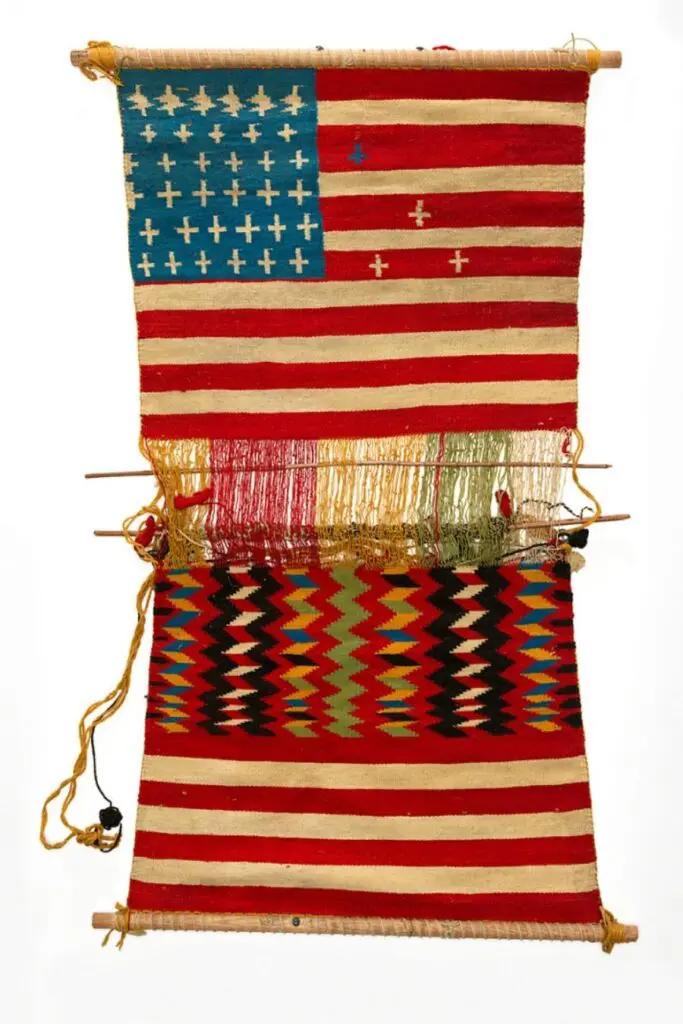
Loom with Textile | Likely made by Navajo (Diné) weaver Juanita, ca. 1874 | Image via The Smithsonian
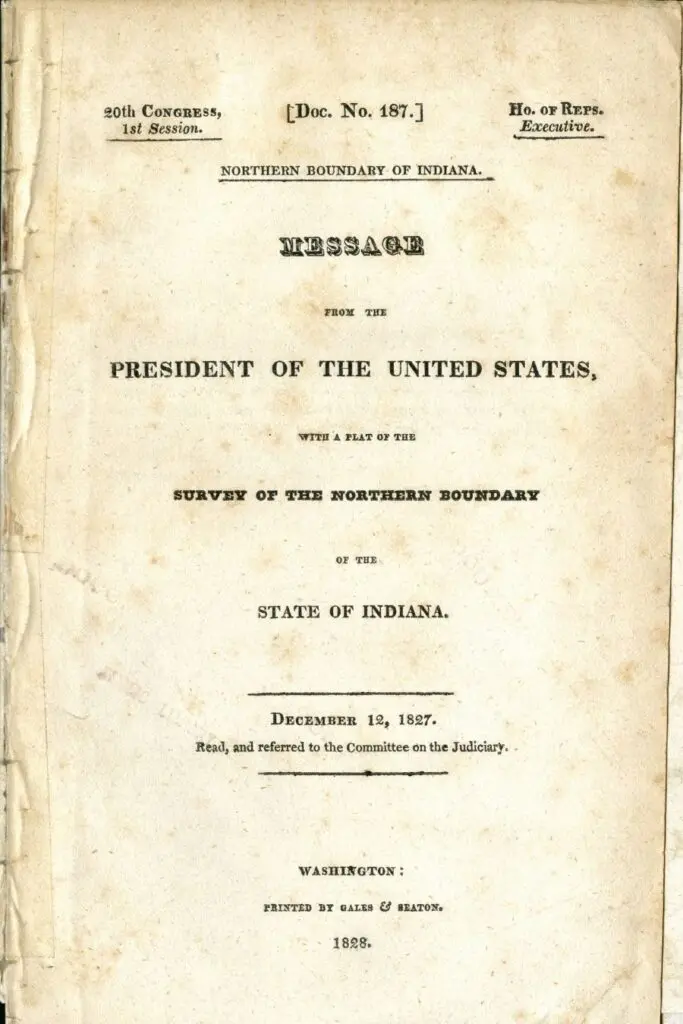
Message from the President of the United States with a plat of the Survey of the northern boundary of the State of Indiana. | ca. 1828
What do our families pass on to us? Christmas of 2022 was the last time I ever saw my babcia. She passed very unexpectedly a few months after the holidays, and with her passing I also lost the most direct connection to my Polish roots. Growing up I always felt the pride she had at her Polish-ness, but still felt a disconnect between our family and any real old-world traditions. Mine is the sort of American Polish family whose understanding of the language has long since dematerialized, who enjoy Martin’s fried chicken on the same plate as Polish sausage, and who can wish you a Happy Dyngus Day with the best of them. But what my family lacks in heritage traditions my babcia always made up for in tight hugs and big wet kisses on the cheek when we gathered on Christmas morning.
Reconnecting with Polish Traditions
But as I’ve gotten older and sought to reconnect with Polish traditions that my ancestors and great-great grandparents might have practiced before moving to South Bend at the turn of the century, I’ve learned that no matter what the practice is, loved ones are almost always at the heart. This is the case with Wigilia (vee-gee-lee-ah), one of the most important days for people of Polish heritage and descent. Wigilia, which takes place on December 24th, offers the chance to rest, reflect, and ready ourselves for the year ahead. It’s about setting intentions, making amends, repaying debts, returning borrowed items, and completing any unfinished business. Making things right before the year comes to a close.
Elements of Wigilia
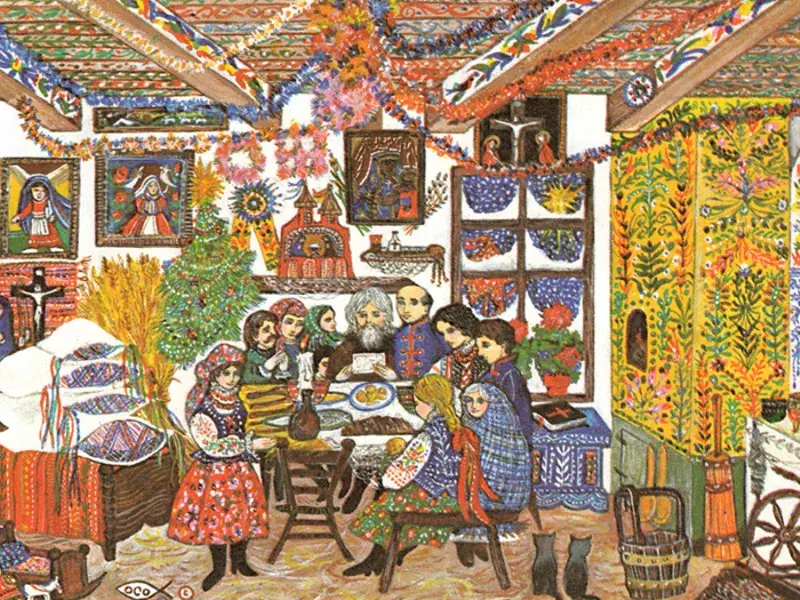
There are several elements to Wigilia that encompass the spirit of mindfulness for past, present and future. Breaking and sharing opłatki (oh-pwaht-kee), or Christmas wafers, between family and friends is a time-honored tradition dating back to the 10th century. Before the meal, everyone takes an opłatek and goes around the table to wish each other good health, abundance, and prosperity for the new year, breaking off part of the other person’s wafer to eat.
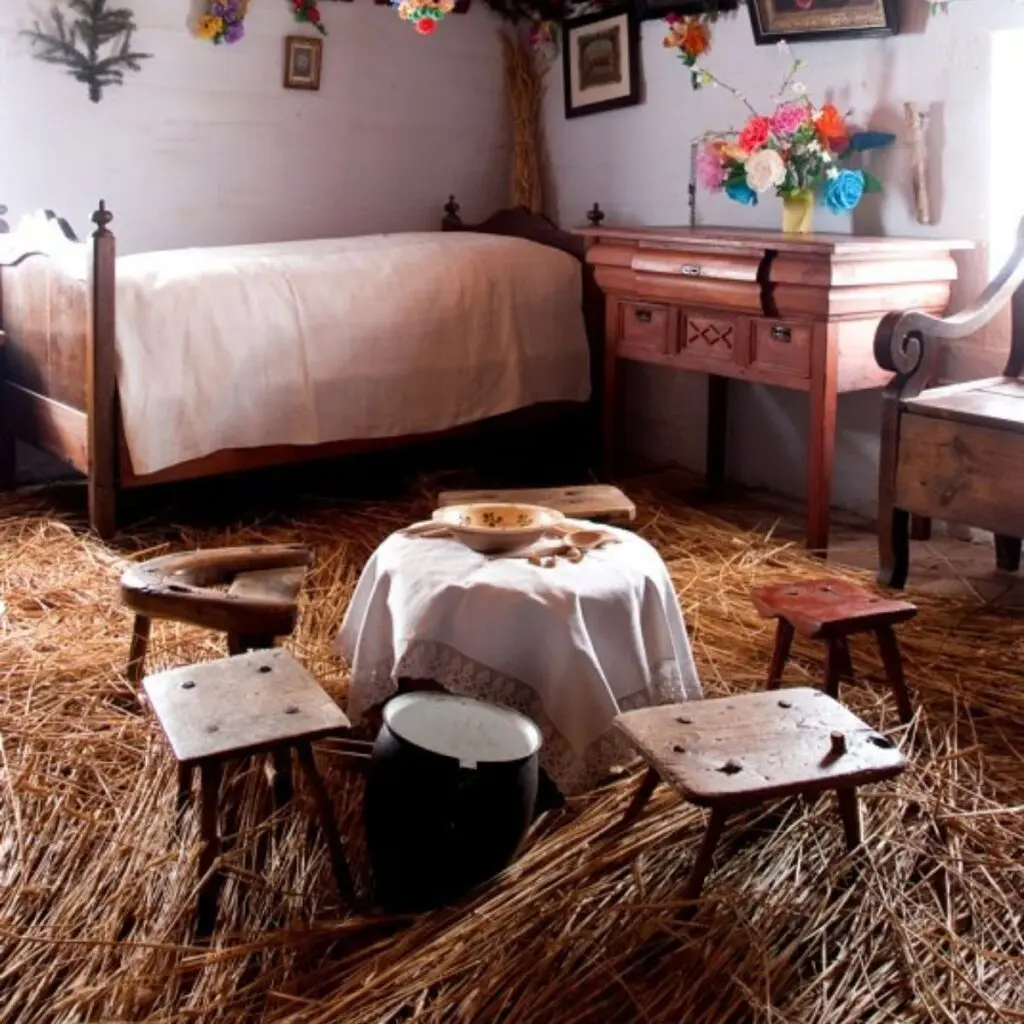
‘Magickal barrier’ made from straw and hay scattered on the floor. | Photo from the Ethnographic Museum of Lublin Countryside.
Breaking the wafer | Photo from Narodowe Archiwum Cyfrowe (NAC) | ca. 1931
An empty seat is prepared at the table for an unexpected guest or for ancestors to share in the meal and festivities. Sheafs of wheat are placed in the corners of the room to represent loved ones who have passed on, and straw placed under the tablecloth to act as a magical barrier that wards off negative energies.
I’ve brought elements of some of these practices into my life over the past few years since losing my babcia, like wearing a wheat brooch on Christmas Eve to honor her memory and trying my hand at crafting Polish holiday decorations. I’ve also upheld some traditions I learned directly from her, like helping myself to an extra kifli or two on Christmas Day. But more than anything, I hope that what is passed on long after I’m gone are traditions filled with love, tight hugs, and big wet kisses on the cheek.
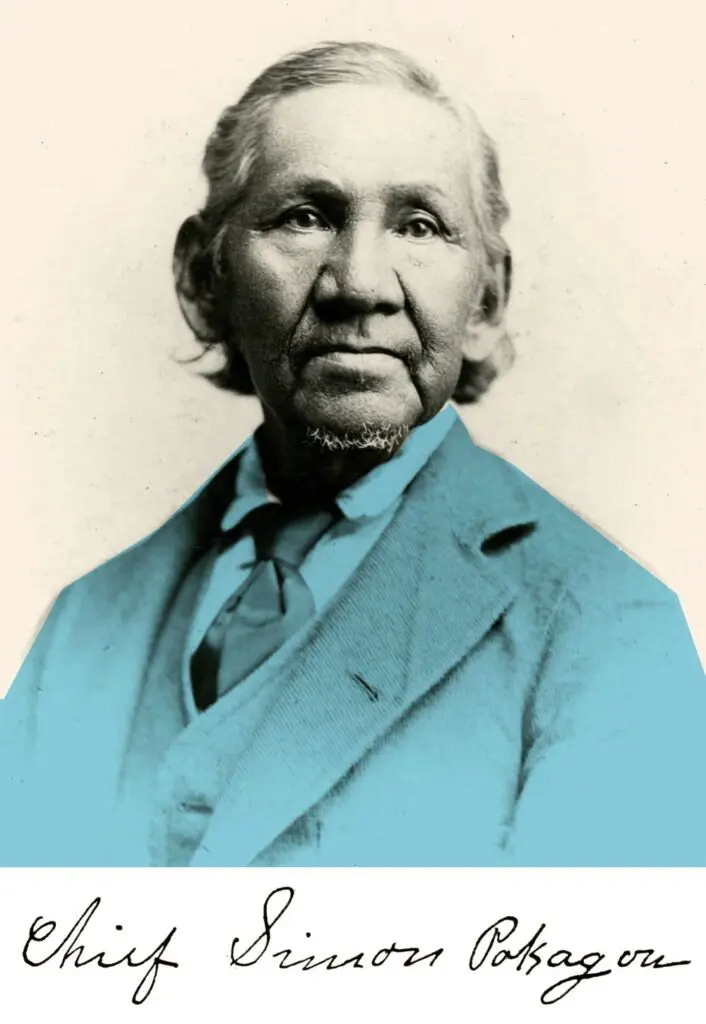
In his time, Simon Pokagon inhabited two worlds. Speaking and writing in Anishinaabemowin and English, he wove together worlds of lived experience and cultural meaning through careful construction and nuanced interpretation. Words and language became the thread, and he worked to stretch past and present tense into a perennial tapestry of human experience. Simon was a gifted storyteller and writer who sought to connect readers and listeners of all races, and to bring to the fore of American thought his personal perspective on Native American life.
Born in the year 1830 in Berrien County, Michigan to father Chief Leopold Pokagon and mother Elizabeth, Simon would know and speak only his native language until he was 14 years old. He learned English while attending Notre Dame school near the current site of the university, and later Oberlin College in Ohio. He soon became an outspoken advocate for Native American rights and the preservation of heritage language traditions held by his tribe. Pokagon believed his people to be vanishing, and so fought for their recognition through speech, prose, and political action.
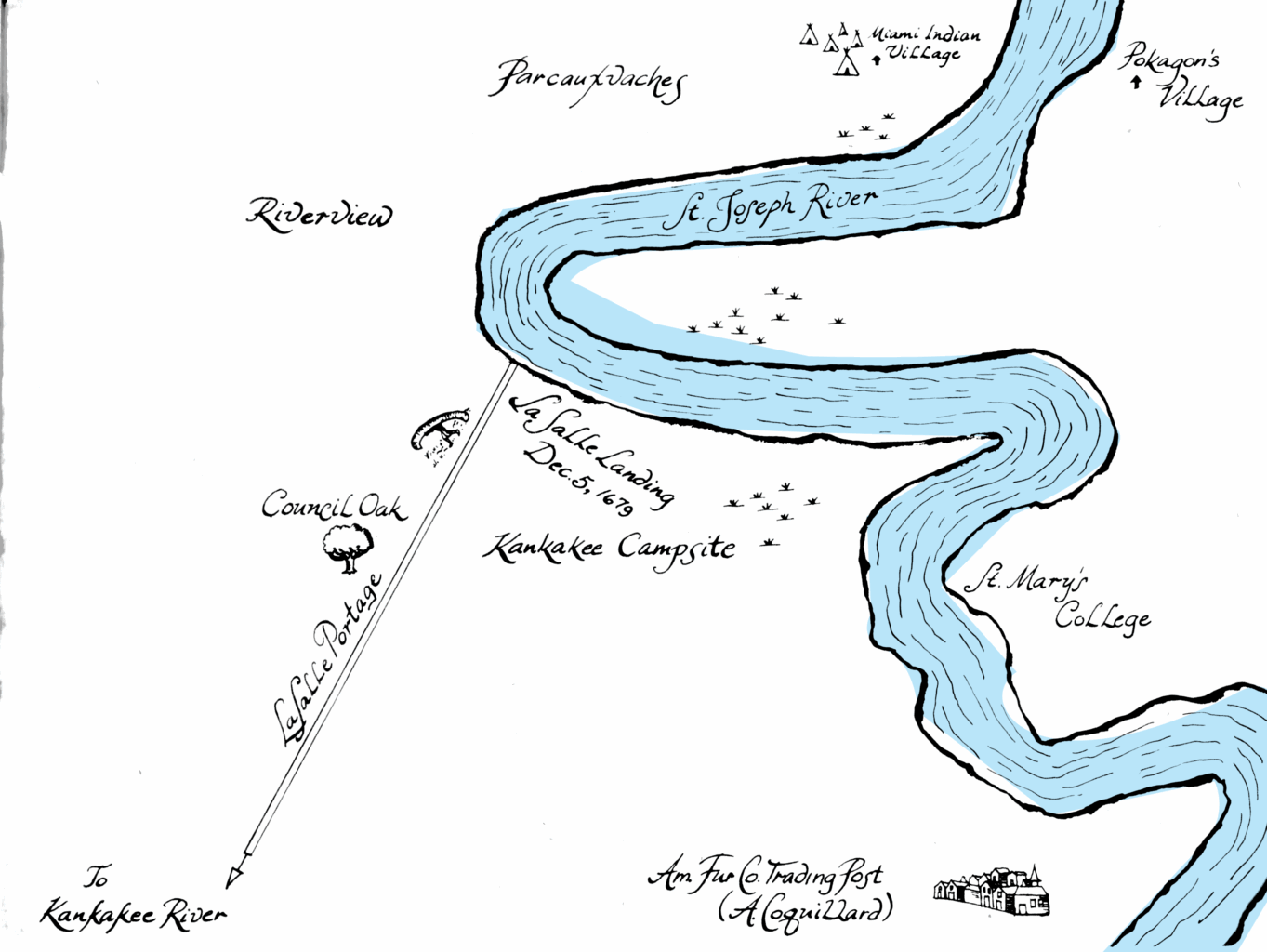
Hand-drawn map of the St. Joseph River with an arrow to Pokagon’s Village in the top right corner
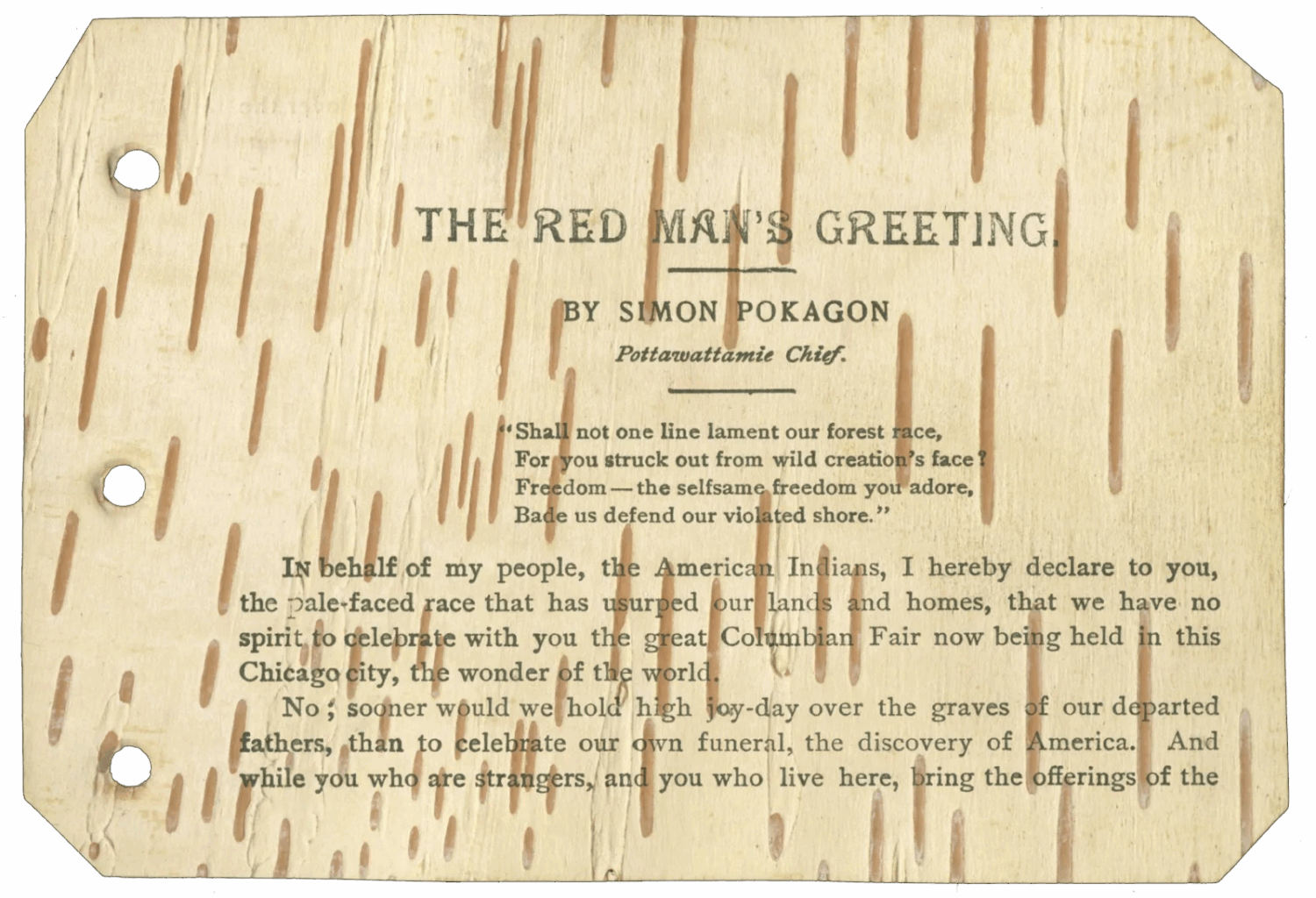
Image from the Newberry Library, Chicago | The opening page of Simon Pokagon’s “The Red Man’s Greeting,” printed on birchbark. Call number: Ayer 251 .P651 P7 1893
In the months following Simon’s death in 1899, one of his works was published with the help of his longtime friend C.H. Engle. The novel Ogîmäwkwě Mitigwäkî (Queen of the Woods) holds to the boundless expression of his native Anishnaabe language while at the same time interposing English as a reflection of the way Simon walked through the world. “It has been said that Greek is the language of the gods,” writes Pokagon in the book’s introduction, “that Latin is the language of heroes, and that French is the language of lovers and novelists; and Pokagon might consistently add that the Algaic language is the three in one, symmetrically interwoven in nature’s great loom.”
References
Pokagon, S. (2011). Ogîmäwkwě mitigwäkî (Queen of the woods): A novel (P.J. Deloria, Ed., J.N. Low, Ed., M. Noori, Ed., K.M. Vigil, Ed.). Michigan State University Press.
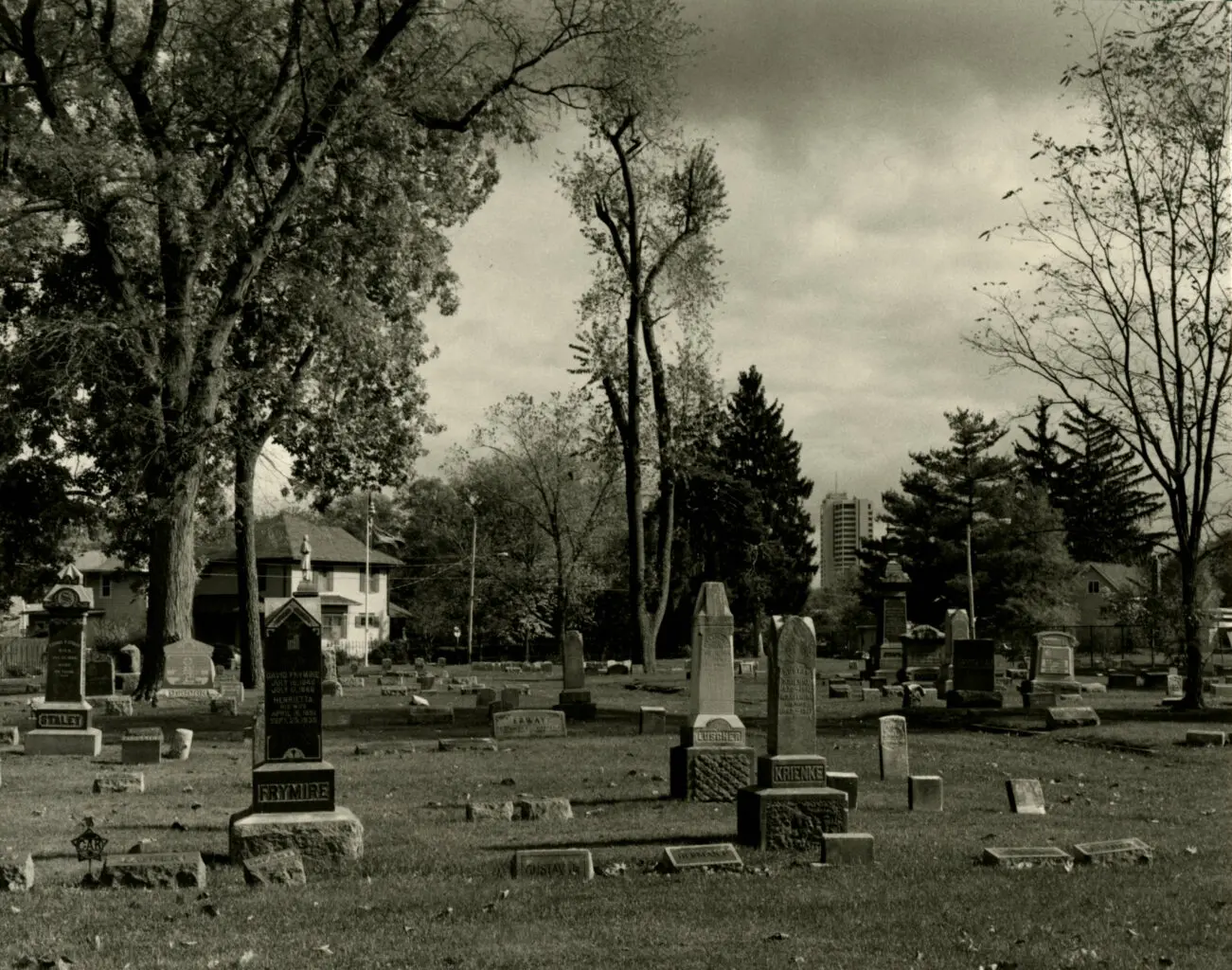
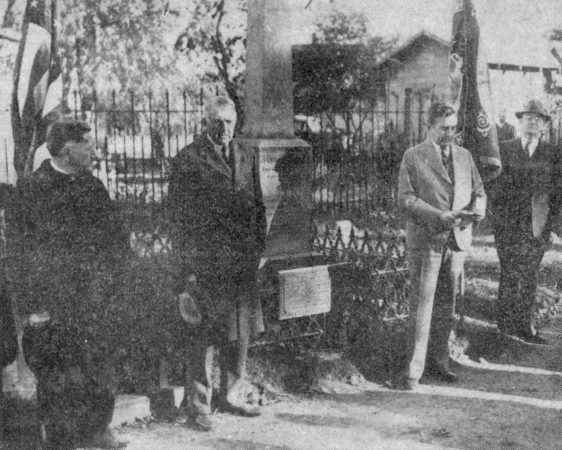
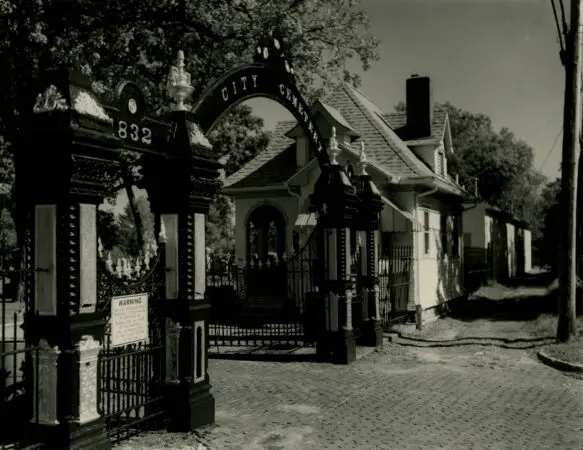
A stone obelisk reaches up into the sky in City Cemetery, a weathered marker of the last spot an elderly couple would share together in South Bend’s oldest final resting place. The cemetery was built on land donated by Lathrop Taylor in 1832, making it only a year younger than the city itself. Lathrop himself is buried there, along with Schuyler Colfax, family members of the Studebakers and Powells, and soldiers from the Revolutionary War. But the originally unassuming grave now marked by a pointed stone monument and brass placard is the final resting place of couple Mary & James McKinley, grandparents to former president William McKinley and early settlers to the South Bend region.
Their meandering journey in 1844 took them 311 miles from the town of Lisbon, Ohio, all the way to South Bend’s western edge where they rented acreage and built a homestead. “No one knew for where they were bound nor their purpose in coming,” wrote reporter Lewis in 1921, “Perhaps they themselves had no particular destination in view…Perhaps, then, the love of the wanderlust was their sole reason for coming west” (South Bend News-Times). Already getting on in age at the time of their grand voyage across the midwest, Mary & James made South Bend their home for only a handful of years before both were overcome with typhoid fever. Their tragic love story ends in that home they built together on the edge of town. Mary fell ill first, and James shortly after. For three weeks they were at each other’s sides, constant companions, but on that late summer day, August 20th, 1847, within hours of each other they both faded peacefully from waking life, on their 43rd wedding anniversary.
The couple made their mark on the town of South Bend in their own quiet way, leaving behind a “saddened village” at the news of their passing. They were laid to rest side-by-side, as together in the afterlife as they were in their journeys through life and across the wild terrains of the early midwestern frontier. The memorial obelisk can be spotted among other ancient headstones in the cemetery, some speculating that its construction was the first presidential act of William McKinley as a way to honor his grandparents. The monument still stands, a testament to the long, storied life Mary & James shared together and to the hope that love can carry on long after we are laid to rest.
Honoring the memory of the martyred president, William McKinley, members of the Harry O. Perkins Camp 25 dedicated a marker at the grave of his grandparents, Mr. and Mrs. James McKinley, Sunday afternoon at City Cemetery. Shown above are those who took part in the program. From left to right they are: The Rev. J.C. McGinn, Colonel George W. Studebaker, Floyd O. Jellison and Marion Esarey. | 1937-11-1, South Bend News-TimesCity Cemetery, undated | Photo by Louis Sabo
References
City of South Bend Venues Parks & Arts. (2025). City Cemetery. SBPVA.
Schuyler Colfax Chapter Daughters of the American Revolution. (1927). Historic background of South Bend and St. Joseph County in Northern Indiana. Schuyler Colfax Chapter Daughters of the American Revolution, South Bend, Indiana.
Lewis, G. (1921, Oct. 2). McKinley’s grandparents early settlers in St. Joseph County; both died on same day, their wedding anniversary; bodies lie in City Cemetery. South Bend News-Times.
Grave of McKinley’s grand parents in South Bend. (1901, Sep. 14). South Bend News-Times. Cahill, A. (1935, Aug. 11). May beautify City Cemetery with WPA aid. South Bend News-Times.
Want to be in the know with the latest library news?