


The Council Oak: Witness to History
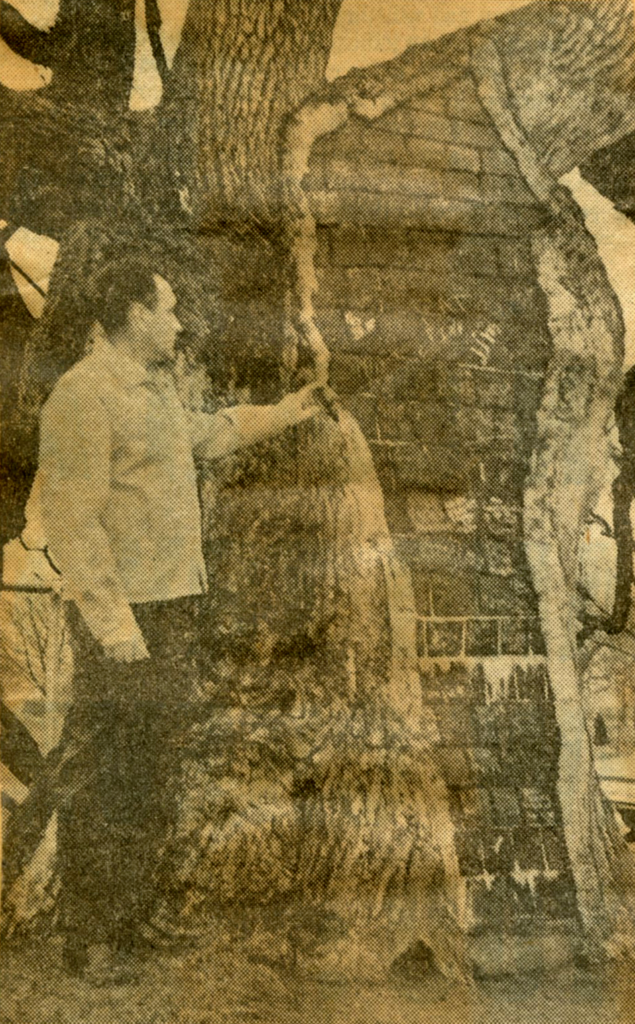
BRICKS PRESERVE TREE
Edsel Wiseman, owner of Moore Tree Experts, 51933 Orange Rd., points to a large hole which was filled with bricks to help preserve the Council Oak. Two large trunk limbs were ripped away during a wind storm 25 years ago. | South Bend Tribune, April 3, 1966
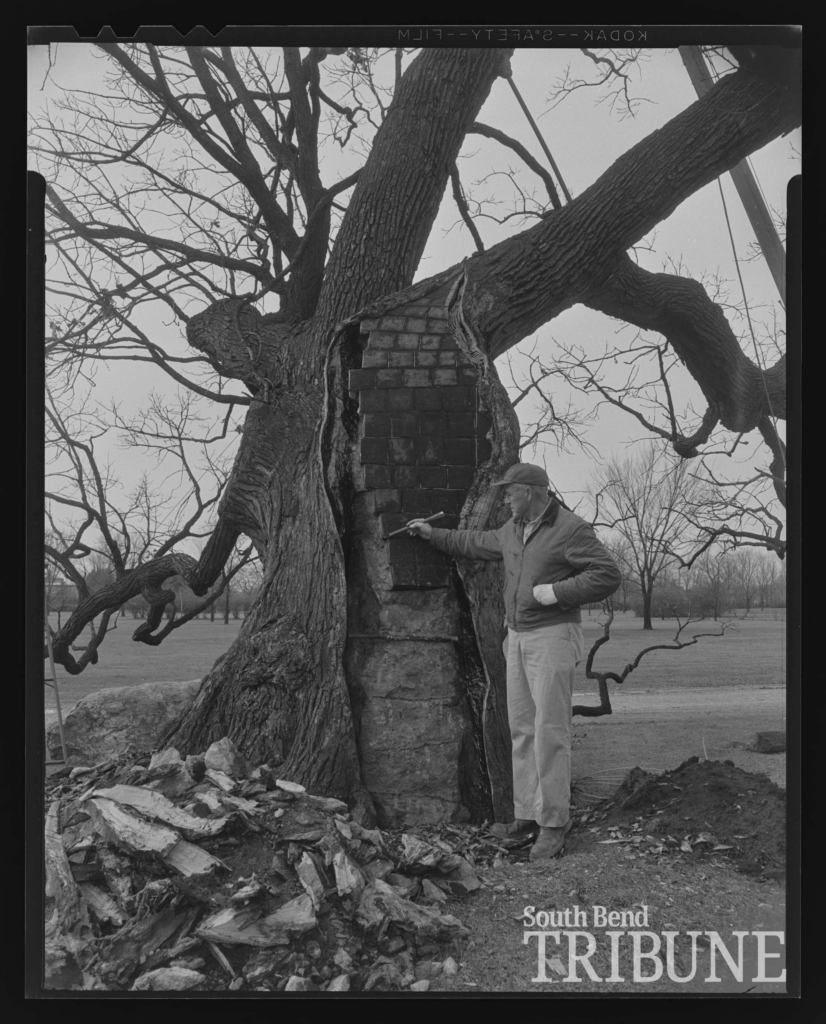
Oscar Munson
Oscar Munson, a tree surgeon, is making an effort to further preserve the landmark Council Oak tree located in Highland Cemetery. | 1957-11-17
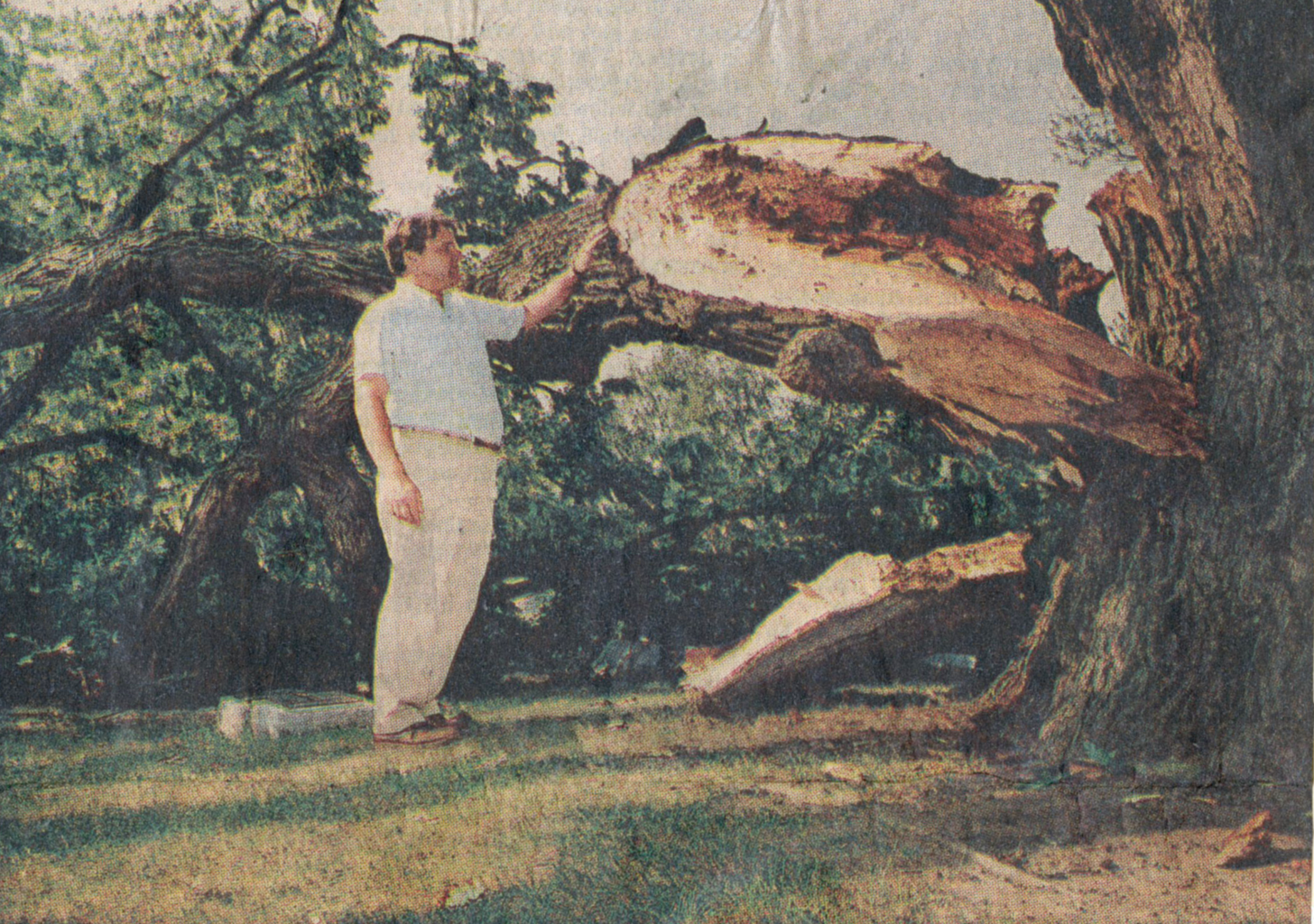
A Living Monument Rests
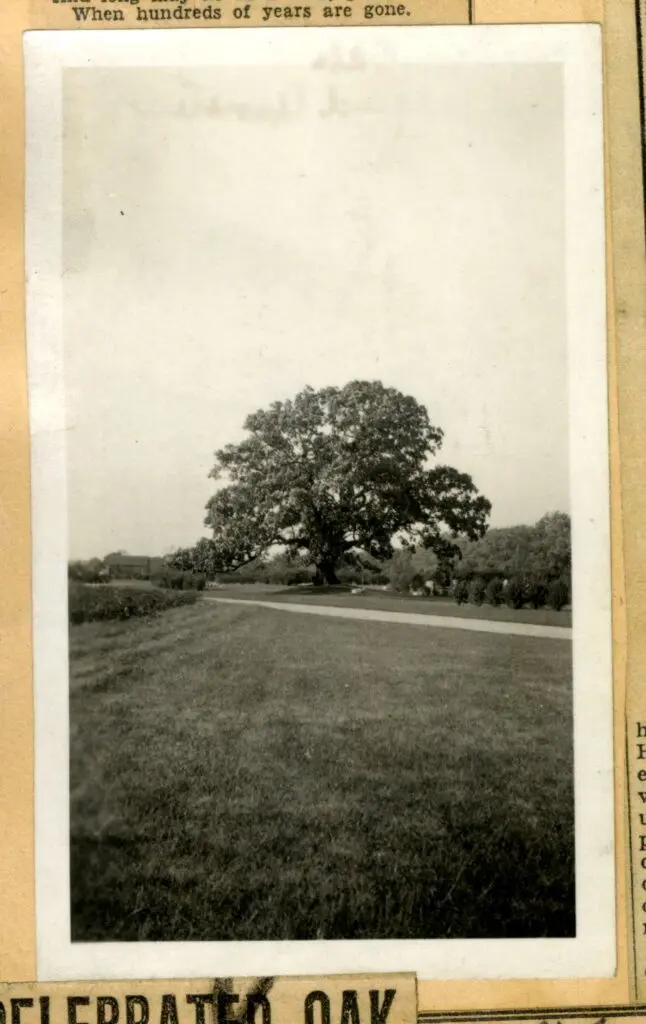
Edsel Wiseman looked up at the ancient oak. “Everything has to end,” he said. It was 1991, and the enormous tree had put its branches to the wind for a final time. A summer storm split the trunk and folded the outstretched limbs down to earth, where they lay draped over gravestones at Highland Cemetery. Wiseman was no stranger to the Council Oak. Over decades he performed and consulted on several rounds of arboreal surgery and the construction of support systems to prolong the life of the St. Joseph County sentinel. But even before Wiseman took on the task of maintaining the tree, others before him watched over it and saw to its slow and steady preservation in life and legend.
Centuries of Holding Space
The Council Oak was witness to hundreds of years of history, estimated to already have been four hundred years old at the time of LaSalle’s journey in 1681. The French explorer, whose name can be found all over South Bend, first landed at the Kankakee portage in December of 1679. A few years later LaSalle and his group held a meeting with representatives of the Miami, Illinois and Potawatomi nations to form an alliance against the Iroquois. The legend holds that this meeting took place under the sweeping branches of the Council Oak, and that it acted almost as an included party. Before America existed as we know it, the tree sat on open land, an adolescent waypoint for Native Americans and foreign travelers alike. Then its surroundings were cultivated into farmland, where the oak watched as plantlife all around shot up from the soil to join its wonderment for the sun. As the property became Highland Cemetery, the Council Oak found itself in the company of other souls laid to rest.
Wisdom of the Oak
In almost every writing you can find about the Council Oak it is alive and observing. It is aware, as all living things usually are, of who and what is around, and that the years are ticking by while it holds a reverent watch. But while it lived, it was participating in history and daily life as it happened. It is just as likely that it held steady as children climbed its limbs, as squirrels squabbled and threw acorns from its branches, as birds nested and sang in its company, as someone young and unsure rested against the trunk and looked into its canopy to ground themself in the certainty of growth. And just like the oak did, we should embrace the breeze and the feeling of sun on our skin, marking each moment in time like a sacred ring, and remembering those who helped support us along the way.
References
Dits, J. (1991, October 13). Branching out. The South Bend Tribune, p. G1.
LaSalle in Hoosierdom: souvenir quarto-millennial anniversary of LaSalle’s Indian council May 1681 – May, 1931 South Bend, Indiana. https://michianamemory.sjcpl.org/digital/collection/p16827coll3/id/1191/rec/4
https://www.potawatomi.org/blog/2016/07/20/the-potawatomi-at-council-oak/


